Georgia Garden Girl

Garden Great in Zone 8!

Weekend Update

It was an exciting weekend at my house.  The weather was gorgeous, and I was able to get a lot of work done in the yard.  I also attended the hypertufa workshop at Columbus Botanical Garden—I’ll give you an update on that as soon as I pick up my beautiful creation later this week.  But I know you’re on pins and needles wanting to know what garden tasks I accomplished this weekend, so here is my report.

It is the busiest time of year for me.  I am a procrastinator by nature, so I usually put off important garden prep work until the last possible minute.  Last year, I didn’t even start building my tomato ladders until after my tomatoes were in the ground.  Big mistake.  I decapitated a poor little Cherokee Purple when I dropped one of the “rungs” on it.  And I ran out of steam when it came to weeding an area where I was going to plant tomatoes, so I decided that I would just till it, put down newspaper, and hope for the best.  Well, the newspaper did work for a while, but it was no match for the aggressive encroachment of the dollarweed a/k/a pennywort a/k/a the weedy bane of my existence (for me, the only weed worse than dollarweed is chamberbitter a/k/a little mimosa a/k/a gripeweed a/k/a just plain horrible awfulness).

This year, I am determined to do better.  And I am happy to announce that I appear to be on the right track.  Mainly because the soil temperature hasn’t reached a consistent 65°F, so I haven’t wanted to plant my veggies yet and I’ve had more time for prep work (thank you, cold snap).  If you’re not sure whether your soil is warm enough for you to plant, you can just use your meat thermometer.  Or you can check http://www.georgiaweather.net/.

Anyway, my two main tasks at this point are (1) weeding and (2) building supports for my vegetables.  This weekend was a perfect time for both tasks.  The ground was still soft from last week’s rain, so weeds came out of the ground fairly easily and the supports went into the ground without a herculean effort.  So I weeded and weeded and weeded.  Then I tied together a lot of bamboo.  And then I weeded.  Then I selected the twenty-one tomato plants (out of the fifty or so I started from seed) that will live in my yard this summer.  And then I weeded and weeded and weeded.

You may wonder why I spent so much time weeding.  First, I have a lot of weeds.  I’ve been lazy about eradicating weeds in the past, plus the two yards behind mine are basically jungles whose weeds send their seeds into my yard.  Darn them.  Second, if I’ve only learned one thing in my six years as a homeowner/aspiring gardener, it’s that there is no substitute for good old elbow grease when it comes to weeding.  I’ve tried weeding-by-tiller.  But I still have to pull up the weeds to prevent re-infestation.  I’ve tried a weed-whacker.  But I wasn’t getting the roots, so the weeds grew back, plus it was easy to maim the plants I wanted to keep.  I’ve tried an herbicide.  But I accidentally injured or killed some of my good plants when I did.  So for me, old fashioned pulling is the way to go.  Which means I actually have to do it or I’ll be overrun with weeds before the first tomato plant sets fruit.  At times, I feel like Sisyphus—but instead of a boulder and a hill, I have weeds.  But if I keep up with it little by little, surely I will prevail.  And there is good news on the horizon: some researchers in Nebraska are creating a robot to pull weeds.  I am not making this up: http://www.npr.org/blogs/thesalt/2013/02/14/171817006/when-resistance-is-futile-bring-in-the-robots-to-pull-superweeds.  Y’all need to know how much I love my three Roombas.  So when iRobot comes out with a weed pulling robot, I am going to buy it.

In the next week or so, I will continue weeding, and I will put down some mulch.  I will also finish my vegetable supports and then plant my baby vegetables.  When things are presentable, I’ll post some photos!

Happy gardening!

Leave a comment »

Hypertufa Workshop This Weekend!

This Saturday, March 29, 2014, the good folks at Columbus Botanical Garden will show us how to make custom hypertufa containers.  For only $35 ($40 for non-members), you will learn how to make your very own piece of outdoor art!  The workshop is 10:00 am to 1:00 pm.  Bring rubber gloves, a large garbage bag, and a form (e.g., a plastic Rubbermaid container—make sure it’s smaller than one cubic foot).  Sign up online: http://columbusbotanicalgarden.com/event/hypertufa-workshop-2/ or call the Columbus Botanical Garden for more information – 706-327-8400.  Hope to see you there!

Image

Photo courtesy of Columbus Botanical Garden.

If you can’t make it to the workshop but are interested in learning more about hypertufa, check out:
http://www.marthastewart.com/268091/pots-with-a-personal-touch-hypertufa:
http://www.lowes.com/creative-ideas/woodworking-and-crafts/make-hypertufa-pots/project

Leave a comment »

Shelter Them

In case you haven’t heard, we are expecting a freeze TONIGHT, March 25, in middle Georgia. So, if you have started hardening off your summer annuals outside, double check your local forecast. If you’re expecting below the low 30s, bring those babies inside! And if you got a little ahead of the weatherman and already planted your tomatoes, be sure that you cover them tomorrow evening.

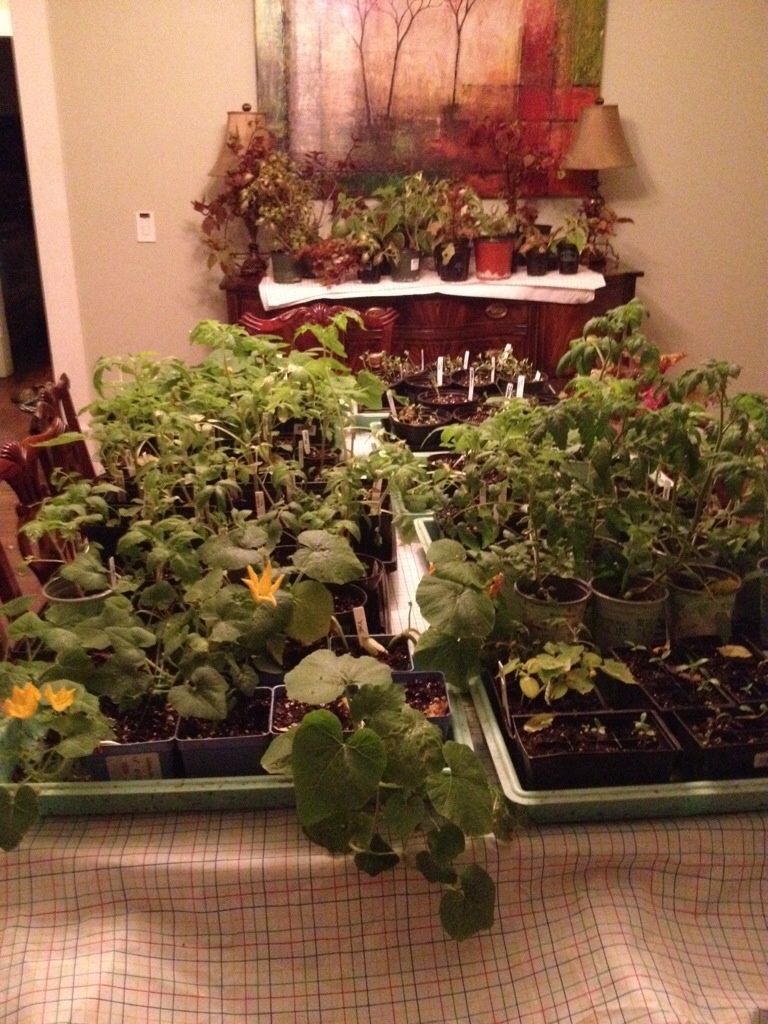
I went ahead and brought in my plants yesterday evening. They will go back outside later in the week. But for now, they have taken over the dining room.

I hope you and your plants weather the freeze!

20140324-210041.jpg

Leave a comment »

Tough Love

Happy Spring, y’all!

I started my tomato and pepper seeds indoors back in January, and I started some other vegetables in February.  These veggies have been living in the lap of luxury in my laundry room—a constant, warm temperature, regular watering with a light stream of tepid water, and gentle yet effective lights.

Now, it is time to prepare my plants for the harsh realities of the world.  They will have to be tough to make it out there, where the temperature fluctuates, cold rain pours, wind blows, and the sunlight is a lot more intense than a little fluorescent shop light.

Obviously, I should not just go ahead and move the plants into the direct sunlight of the vegetable garden.  They need to be moved gradually so they have a chance to adjust.  This process is called “hardening off.”  And it is very, very important.  I learned this lesson the hard way.  During the first year of my vegetable garden, I grew some beautiful tomato plants from seed, and I was itching to get them into the ground.  So I took them from the laundry room where they had been coddled for two months and planted them directly in my raised beds.  Big mistake.  On their first day outside, the sun badly burned the leaves.  Though the plants eventually recovered, my mistake cost me about a month of tomato production time.  I will never make that mistake again.

Now, I have a five-step process for hardening off my plants.  First, I have to figure out when to start hardening off.  A lot of considerations are factored into the calculus of exactly when to start hardening off.  There’s the date (are we within a week or two of our 50% frost date?).  There’s the weather (is there a threat of a frost? will the temperatures generally be in the mid-40s or above at night? are we expecting a monsoon?).  There’s the soil temperature (is it getting close to 60°F?).  In general, I try to start hardening off the plants a week or two before our 50% frost date, which is March 23 in my part of Middle Georgia.  But if it looks like there will be a frost or a bad storm, I will wait.

After I calculate my hardening off start date, I’m ready to move to steps two through five.  Step Two: I start the hardening off process in the carport.

Carport

Step Three: after a couple days in the carport, I move the plants to a shady part of my deck.  Step Four: after a couple days there, I move the plants to a partly sunny part of the deck.  Step Five: after a few more days, I move the plants to a slightly sunnier part of the vegetable garden.  And then, after a few more days, the plants are sufficiently hardened off and ready to be moved to their beds.  Right now, my plants are somewhere between Step Two and Step Three (sorry – I forgot to take a picture).

While you’re hardening off your plants, be careful to watch the weather reports.  If you know there will be a bad storm, you probably want to bring the plants under cover—or at least out of the path of potential falling branches.  And watch the nighttime temperature.  In the 40s, tomatoes and peppers will probably be okay. But not okra.  Last weekend, the nighttime temperatures dipped into the low 40s, and my smallest okra showed serious signs of distress, so it and its brethren are now back inside for a few more days.

The fine folks at the Weather Channel are predicting overnight lows in the low 30s in Middle Georgia on Tuesday and Wednesday of next week; I will keep an eye on the predictions.  If the temperatures do get that close to freezing, I will need to schlep everything back inside at night.

Good luck with your own tough love!

1 Comment »

Lazy Girl’s Guide to Orchid Maintenance

I get a lot of questions from friends about how to care for plants.  The questions about outdoor plants are all over the map (Q: how long will it take my new blueberry bush to produce? A: about 3 years; Q: why did my basil plant turn black? A: it froze; Q: the best thing for my lawn would be to set it on fire and reseed, right? A: Um, wrong.).  But the vast majority of questions about indoor plants are about one type: the phalaenopsis orchid.  Folks are so worried about what to do with these plants!  So today, I would like to dispel some rumors about orchids.

Phalaenopsis orchids (a/k/a moth orchids) are lovely.  Their blooms last at least a month.  They are widely available at florist shops, grocery stores, and big box stores—especially around Valentine’s Day and Mother’s Day.  Phalaenopsis orchids make a wonderful gift, and that gift could last for years (my oldest phalaenopsis is at least ten years old).

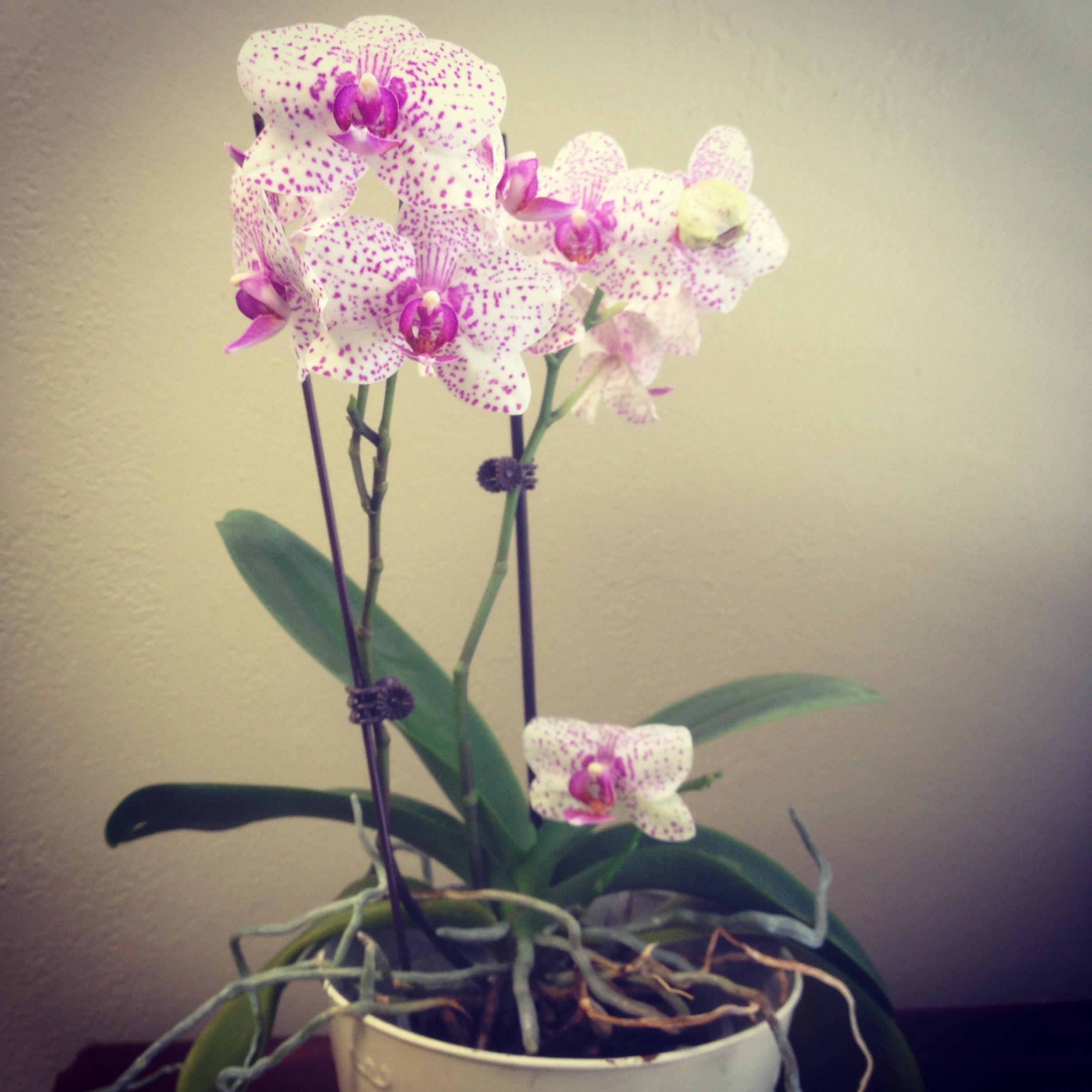
Most folks think that orchids are fussy and hard to grow.  I too had been led to believe that orchids must be coddled with special light, special fertilizer, and constant care.  Hogwash!  I have had excellent results without spritzing “just so” or even remembering to fertilize on a regular basis.  In fact, all of my phalaenopsis orchids are currently blooming.  Do they look exactly like the ones that were carefully raised in a fancy commercial greenhouse?  Mercy, no.  But they do have flowers, and I think they’re glorious.  See?

IMG_2080   Office Orchid

Here are the major steps I followed.  Disclaimer: my “techniques” have not been approved by any extension services or orchid societies.  Obviously.

  1. I put them near a window.  Phalaenopsis orchids are great because they don’t require a whole lot of light, and they are happy with the temperature in my house (between 65º F and 80º F, depending on the season).  Before I had my shop light set-up in the laundry room, I kept my orchids in a bright window, and that worked just fine.  Now, they are under the shop lights until they bloom.  When an orchid is blooming, I usually put it on display somewhere out of direct light so that the blooms will last longer.  If it’s been a while since your orchid bloomed, it might need more light.
  2. I did not repot them in soil.  Your orchid will likely come potted in bark or moss.  That is because orchids grow best in soilless mixtures.  The experts say to repot orchids every one to three years.  Um, okay.  My orchids are not on an official schedule.  When the roots are spilling out of the containers, I think, “Hey, maybe I should repot that.”  If I have the same thought several times and I happen to have some orchid potting mixture handy, then I might repot the orchid.  But I do always use an orchid potting mixture and not regular potting soil.
  3. I did not let them sit in water (most of the time), and I did not forget to water them (most of the time).  The experts will tell you to water in the morning, placing the plant in the sink and using tepid water and an elaborate ritual that involves letting the water run through the plants for a minute/letting the plant drain completely/gently wiping excess water off the leaves.  If you have time to do that, great.  If not, just make sure they do get watered.  Let them dry out a little before you water them again—if the pot feels heavy, skip watering.  My orchids are all potted in a bark medium in plastic pots.  The pots sit in seedling trays.  I spray water into their pots using an indoor hose that is connected to the laundry room sink.  Occasionally, I accidentally overwater, and water remains in the tray/on the leaves.  They lived.  And although I know I’m not supposed to let the orchids dry out completely, it has happened.  They lived.  My orchids are not on a strict watering schedule, but I’d say I typically remember to water them about once a week.
  4. I occasionally remembered to fertilize them.  But really not that often.  The experts advise using an orchid fertilizer.  Some even recommend special fertilizers based on the season—a high nitrogen fertilizer in the spring, and a high phosphorous fertilizer in the fall.  They recommend feeding weakly (about half strength) weekly or feeding monthly.  Yep.  I haven’t quite gotten there yet.  I do know that too much fertilizer is bad, so I don’t feel terrible about forgetting to fertilize the orchids.  I bought some orchid “bloom booster” fertilizer several years ago, and when I happen to see it sitting on the shelf and happen to have a gallon jug free, I might mix up a batch and feed the orchids.  It might happen once a quarter.
  5. I did not expect miracles.  Phalaenopsis orchids bloom once a year.  That’s it.  So I knew that I wasn’t going to get more flowers shortly after the old ones faded.  Okay, if you know how to prune the stem, you might get a second bloom.  I have never had much success with stem pruning, so I just cut the stem off when the flowers have faded and wait until next year’s blooms.  When the orchid does bloom, the flowers last for weeks.

Now, as you can see, orchids need not be daunting.  They can be beautiful even with imperfect care.  But if you are interested in knowing how to grow orchids the “right way,” check out the tips from the American Orchid Society.

3 Comments »

Time to Get Ready

Y’all may as well know.  I love to-do lists.  I love making to-do lists, and I especially love crossing things off my to-do lists.  It’s just about time for the weekend, and that means that my garden to-do list is getting long!

We’ve had some glorious weather in middle Georgia over the past couple of days (though it did get downright cold last night).  I’m sorry to say that our friends at the Weather Channel are not predicting similar gloriousness this weekend.  It is supposed to be cloudy on Saturday and rainy on Sunday.  But that will not stop me from trying to cross a few things off my list:

  • Divide perennials and give leftovers to friends.  I didn’t get around to dividing my spring and summer perennials at the ideal time (October).  It was football season—give me a break.  But now is also a good time to divide.  Mama says, “If you have to buy hostas, you don’t have any friends.”  So get digging and share your wealth of daisies, hostas, black eyed susans, sedums, etc.
  • Weed and mulch perennial beds.  While I’m dividing the perennials, I may as well pull some weeds and then put down some mulch.  If I’m feeling extra industrious, I’ll mulch with old newspapers and then pinestraw—that will save me some weeding time in the summer.
  • Start hardening off vegetable seedlings and coleus plants.  I overwintered my coleus plants inside and rooted some new ones.  Now, I have six flats of coleus plants, and I’m ready to get them out of the kitchen/dining room/living room.  And I started my tomato and pepper seeds back in January, plus some other veggie seeds in February.  They are getting too big to stay under the lights.  Here’s what they looked like last weekend:
    20140309
    (Yes, those are pumpkins in the middle on the bottom—I was doing some germination tests, and I’ve decided to keep on testing.  Don’t judge).
    Anyway, before I plant any of these babies outside (which I will NOT be doing this weekend), I need to get them used to the sun and the temperature.  So, I will put them outside in a shaded, sheltered location for a few days, and I will gradually transition them into the sunny spot where they will spend the summer.  And if I receive a frost warning, I will bring them right back inside!
  • Check outdoor faucets and hoses for leaks.  My plumber friend is coming by next week to give me an estimate on a bathroom remodel.  While he is at my house, I may as well see if he can fix any outdoor faucet leaks, which means that I need to figure out where the leaks are this weekend.
  • Prune the dwarf yaupons.  It’s a good time to prune ornamentals like hollies and boxwoods.  And if your oleander froze, you probably want to cut that back too.  For pruning tips, click here.
  • Trim the liriope.  Okay, I’ve already done this one.  Isn’t it nice to have something already off the list?  But if you haven’t trimmed your liriope, you probably want to go ahead and get that done before the new growth starts.  Just take a string trimmer to it.  Or, if it’s a large area of liriope and there are no nearby barriers (say, metal or concrete edging), just take your mower, set it to its highest setting, and mow the liriope.

One thing I will NOT be doing this weekend is planting my summer vegetables outside.  I know they’ve got them in the stores, but that doesn’t mean you need to plant them.  Our 50% frost date isn’t even until next Sunday, March 23.  Plus, the soil temperature isn’t warm enough yet.  It is getting mighty close, though.  Remember, we need the soil temperature to be at least 60°F for tomatoes, 65°F for okra, and 70°F for peppers.  Down in Quitman County, the 2 inch soil temperature was about 60°F earlier today, and the 4 inch soil temperature was 56.8°F.  Up in Harris County, the 2 inch soil temperature was 58.7°F, and the 4 inch soil temperature was 53.7°F.  You can check your soil temperature using a meat thermometer.  Or you can go to http://georgiaweather.net/.  The upshot: don’t plant your summer vegetables outside now unless you want to (a) stunt their growth and (b) cover them or dig them up in the event of a frost.  All right.  I’ll get off the soapbox now.  If you really want to plant your tomatoes now, that’s your journey.

I hope you have a marvelous weekend.  And I hope you cross many tasks off your to-do list!

Leave a comment »

Resist the Temptation!

Hey y’all. The calendar says it’s spring, but it turns out that General Beauregard Lee had it right and Punxsutawney Phil had it wrong this year. Lesson learned: never trust a Yankee groundhog.

Listen, I know I’ve told you all about frost dates. And I know I told you that our 50% frost date in middle Georgia is March 23. I know you’re itching to get some tomatoes in the ground. But please DROP THAT TROWEL AND TAKE THAT TOMATO SEEDLING INSIDE!

The frost dates are a great guideline, but you’ve got to use common sense and you’ve got to check the soil temperature. The weather folks are predicting some chilly overnight lows in middle Georgia this week. Lows that may harm your warm season plants. And the fine folks (and/or computers) at the Georgia Automated Environmental Monitoring Network say that the soil temperatures in middle Georgia are only in the low to mid 50s. Remember, you need the soil temperature to be at least 60 for most warm season crops (65 for okra).

This girl’s meat thermometer says the soil temperature of her raised beds is only 54, so my tomatoes are going to be coddled inside just a little more. Sure, I’ll take them for a stroll during the day to get them used to the sun, but those babies are sleeping inside.

Please protect your plants too! If you jumped the gun and put them in the ground already (Did you already wear white shoes too? Bless your heart!) make sure you cover them when the overnight low dips into the 30s. Good luck!

2 Comments »

Seed Starting Update

Hello, friends.  I planted my tomato seeds in late January/early February, and I promised you an update.  I hope your own seedlings are doing well.  Here is how mine are doing:

Tomato Seedlings as of February 25, 2013

Tomato Seedlings as of February 25, 2013

As you can see, most of them sprouted and have developed at least one set of real leaves.  Unfortunately, no Green Zebras or Sweet Millions have emerged, so I have to decide whether to plant some late seeds.  If I do (and if they actually germinate this time), then the plants will not be ready to plant outside until April.

Here is my second flat, which has tomatoes and peppers and was planted a couple weeks after the first flat:

Jack "warms" the tomato and pepper seedlings.

Jack “warms” the tomato and pepper seedlings.

My cat Jack decided that bottom shelf under the shop light/on top of the seedlings would be a great place to nap.  Oh, well.  Most of the tomatoes had barely emerged, so I did not lose any.  I’ve yet to see a pepper, which concerns me a little.  Perhaps I need to bring out the heat mat.

By the way, the local big box stores already have tomatoes!  Right now, there are not too many varieties.  I’m fairly sure that the ground is too cold for tomatoes (they need a ground temperature of 60° F), plus the weather folks predict that we will have frost this weekend in some parts of Middle Georgia.  But if you just can’t resist buying a tomato plant, at least go ahead and replant it in a gallon pot and keep it watered.  If you don’t have a cold frame, bring that baby inside on Saturday.

Happy growing!

Leave a comment »

Thou Shalt Not (Crape) Murder

Ladies and gentlemen, sharpen your clippers.  It’s time to prune in Zone 8.  Before you go to your yard and start whacking, make sure you know what needs to be pruned, what doesn’t need to be pruned, and the basics of how to prune.

The most common pruning question I get relates to the crape myrtle.  People ask, “I see that lots of people cut their crape myrtles way back.  Do I have to do that?”  I say, “Heck no!”  Horticultural experts and master gardeners refer to the practice of hacking off the top of a crape myrtle as “crape murder.”  Southern Living even has a contest to find the worst perpetrators because Steve Bender (aka SL’s Grumpy Gardener) reckons that the “best way to stop crepe murder is to humiliate the criminals by posting photos of their heinous acts on The Grumpy Gardener” website If you will promise to refrain from crape murder, I will promise not stop my car to take a picture of your landscaping and post it on the internet for all the world to ridicule.  Plus, you will not waste your valuable time on unnecessary work.

First things first, though.  I should start by explaining why to prune, when to prune, and how to prune.  Then I’ll address specific plants, including the crape myrtle.  Before I sat down to write this post, I thought it would be easy to condense this topic into an article of reasonable length.  Ha!  There are hundreds of books and articles about pruning.  I checked several books out of my local library and browsed a few others at a local bookstore, and I reviewed dozens of articles.  I was happy to discover that these sources are all very repetitive, which I suppose is good—everyone agrees on the basics.  I also realized that sometimes a drawing or picture really helps.  Given that I have removed most of the “pruning nightmare” plants from my yard, I don’t have many great examples that I can photograph, so I need to point you to someone else’s photos.  And if I tried to draw pictures it would take me so long that it would be autumn before I could publish the post, and autumn is generally not a good time to prune, so I need to point you to someone else’s drawings.  For these reasons, I decided to try to put together a clearinghouse of information, which is mostly from the following trusted sources: UGA Extension Service, Clemson Extension Service, Walter Reeves, Southern Living, Pruning Trees, Shrubs & Vines by Karan Davis Cutler (a publication of the Brooklyn Botanic Garden), Gardening in the South by Don Hastings, and Georgia Master Gardener Handbook.

Why to Prune
Safety First.
  Let’s say you’ve got a tree whose branches are unhealthy and loom precariously over your neighbor’s garage.  Prune!  Or a tree whose branches are tied up in the power lines.  Call the power company and ask it to prune (then call a line-certified tree guy when the power company says “that’s not our line”)!  Or a bush that blocks your view of the road from your driveway.  Prune!  Or a bush that invades your neighbor’s property year after year (yes, neighbor, I’m talking about that cherry laurel and privet you let creep under the fence into my vegetable garden).  Prune!

Prune for Health.  For any woody plant from a tree to a shrub, you need to get rid of damaged and dead wood.  Leaving it may promote disease.  If you do have a plant with a disease problem, make sure you sterilize your pruning tools between cuts.  Just dip the blades in rubbing alcohol or a weak bleach solution (one part bleach, ten parts water).  Remove suckers, which are sprouts that come up from the base of the tree or shrub.  Suckers only take nutrients and water away from your plant.  For trees, there are a few other guidelines for good health.  Remove branches that grow inward, branches that grow straight down, branches that cross each other, and branches that rub other branches.  Over time, branches that are permitted to rub together will wound each other and may even affect the trunk of your tree.

Keep Plants In Their Place.  I’m going to preface this one by stating what should be obvious.  If you want a small bush, plant a bush that stays small.  Why plant a Natchez crape myrtle, which will grow 20-30 feet tall, when what you really want is a bush that tops out at six feet?  Plant a Dwarf Snow instead.  And why plant a Burford holly that really wants to be 15 feet tall in front of your windows that are three feet off the ground?  If you want to be able to see out of your windows, plant a dwarf cultivar instead.  You can save a lot of time and energy by simply choosing the right plant for the site.

That said, if you’ve made some bad plant decisions or inherited some plants need to be constrained and you are reluctant to remove them, Prune!  You might even get to prune monthly!  (See above regarding Burford holly vs. windows.)  Remember, if you’re trying to constrain a plant, it’s best not to wait until the plant is already tremendous.  If you have a plant that has outgrown its space and you don’t want to do a single “ground level prune,” then you may need to work in phases so the plant will have a chance to recover—never remove more than 1/3 of the healthy growth during a growing season.  And you should know that some plants won’t recover from a severe pruning (sometimes euphemistically called “renewal pruning”)—don’t try this with boxwoods, junipers, pines, cedar, arborvitae, or yews.

Shape Up.
Whether you want a unicorn-shaped boxwood, an espaliered fig tree, or just a tidy looking row of dwarf yaupons, you’ll need to do some pruning.  I like a natural look, so I usually just try to follow the plant’s shape and take out any wacky rogue branches.  I don’t have a great spot for espaliering, so I’m not the best resource.  Visit http://www.caes.uga.edu/publications/pubDetail.cfm?pk_id=7656#Specialty to get started.  I haven’t got the patience for topiary, so you’ll need to do some independent research to achieve that unicorn.  Check out http://www.hort.cornell.edu/livingsculpture/topiary/index.htm for some basic information and resources on topiary.

Get Productive.
You can affect the productivity of your plants by pruning.  With roses, for example, if you want a lot of smaller flowers, prune lightly.  If you want a few large flowers, prune heavily.  Remember, pruning promotes vegetative growth and may delay the production of flowers and fruits.

When to Prune
The “when” of pruning depends on your hardiness zone and on the plant.  Now, you can remove dead wood any time.  But for other types of pruning, there is a “best” time to prune.  Here in Zone 8, we try not to prune our shrubs and trees during the late fall or early winter because pruning promotes new growth that may be damaged by a freeze.  We prune non-flowering shrubs, including hedges, in late winter or early spring.  And we typically follow the “May Rule” of pruning for flowering shrubs.  Under the “May Rule,” we prune spring-flowering plants that bloom before May after they bloom, and we prune summer-flowering plants that bloom in May or later in late February or early March.  So prune your azaleas, dogwoods, flowering cherries, forsythia, and winter daphne after they bloom.  Also, if you have hydrangeas that bloom only on old growth, prune them after flowering (I realize that hydrangeas bloom during after May, but this is an exception to the rule; old-school hydrangeas only bloom on the previous season’s growth.  If you’ve got Endless Summer or another newer cultivar that blooms on new wood, prune away in February).  On the other hand, prune your roses, gardenias, crape myrtles, tea olives, and camellias in the late winter, before spring growth begins.

Totally confused?  Walter Reeves developed a super helpful chart designed to help you decide when to prune each type of plant.  Check it out.  http://www.walterreeves.com/uploads/WRshrubprunning.pdf or http://www.walterreeves.com/landscaping/shrub-pruning-calendar/See also http://www.caes.uga.edu/publications/pubDetail.cfm?pk_id=6098#Time.  Another helpful resource: the Grumpy Gardener’s list of 10 Plants You Should Never Prune in Fall (Azalea; Flowering cherry, peach, plum, pear, crabapple; Forsythia; Lilac; Loropetalum; Oakleaf hydrangea; Rhododendron; Saucer or star magnolia; Spirea; Viburnum).

How to Prune
Mama had a professional horticulturist come out to her house to show her how to prune her shrubs.  He told her that she should “prune like a ballerina.”  I’m pretty sure he did not mean for her to put on a tutu and tiara.  What he meant is that for most plants, you need to follow the shape of the plant, and you should proceed gently.

First, make sure you have the equipment you will need.  Most of us need hand pruners and lopping shears.  Those of us who want to prune trees may also find it helpful to have a pole pruner.  And those of us who want to prune hedges will need some hedge shears.  For more information on pruning tools, see http://www.caes.uga.edu/publications/pubDetail.cfm?pk_id=7656#Tools.

Second, you might find it helpful to know some basic science behind pruning.  The extremely abridged CliffsNotes version is this: pruning promotes growth, and most regrowth occurs within six to eight inches of the cut.  For more information on the science of pruning woody plants, including an explanation of terminal buds, lateral buds, nodes, apical dominance, auxin, responses to pruning, etc., please see http://www.caes.uga.edu/publications/pubDetail.cfm?pk_id=6098

There are two main types of pruning.  The first type is called “heading back” or “shearing.”  With heading back, you remove the ends of the twigs and branches.  This practice encourages thick growth near the site of the cut, and the most vigorous growth will be near the cut and toward the outside of the plant.  This may sound great, but as Walter Reeves says, if you head back to just one height (as you might with power hedge clippers), “you’ll end up with an eggshell of greenery covering an interior of brownery.”  That’s because you need light to reach the interior of your plant in order to have leaves grow there.  The solution?  If you want to head back your hollies or your boxwoods, try to head back to several different heights.  And make some thinning cuts (see below) so the light can get to the inside of your plant.  Caveat: this technique will result in a less formal look.  For information on pruning hedges, see the “Hedges” section of http://www.caes.uga.edu/publications/pubDetail.cfm?pk_id=7656#Guidelines

For most plants, the preferred method of pruning is called “thinning.”  With this method, you remove the entire branch or shoot all the way back to the main trunk, limb, or branch.  This approach encourages new growth within interior portions of a shrub.  The best way to prune a tree is to cut back to the main trunk, a lateral branch, or a bud.  Never ever leave a stub!

For more information and to see some pictures of proper pruning techniques, see http://www.caes.uga.edu/publications/pubDetail.cfm?pk_id=7656#Technique, http://www.caes.uga.edu/publications/pubDetail.cfm?pk_id=6098#Types, and
http://www.clemson.edu/extension/hgic/plants/landscape/trees/hgic1003.html.

Pruning Trees
Improper pruning is the second leading cause of tree death (construction damage is the first).  The most important rule of tree pruning: do not top trees.  In other words, never cut branches back to stubs like the crape murderers do.

Crape Murder in Midtown Columbus

Crape Murder in Midtown Columbus

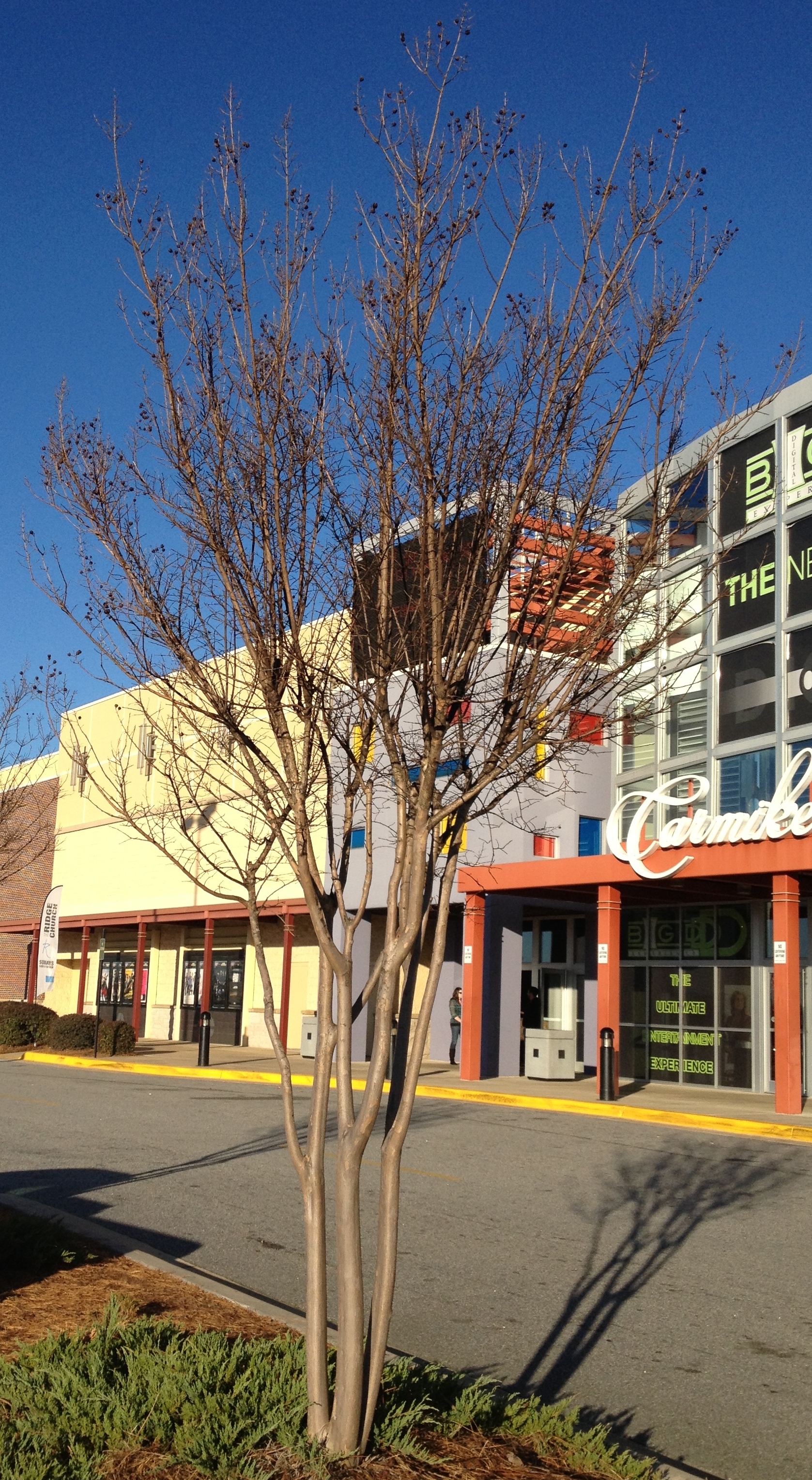
Not Crape Murder

Good job, Carmike! Thanks for not crape murdering!

Why not?  Topping produces a ton of new shoots just below each cut—the tree has to replace all the leaf area it just lost.  The shoots are not strong like the old branches, and they are prone to breaking.  Topping also destroys the natural branching structure of a tree, and it actually makes the tree more top-heavy and prone to wind damage.  And topping opens the tree to decay, infection and insect infestations.  For example, crape myrtles that are topped are far more susceptible to powdery mildew than crape myrtles that are properly pruned.  So what do you do if you think your tree is too tall for its space and you don’t want to take it down?  Thin the tree by removing branches back to their point of origin.  Cut branches back to a strong lateral branch, to the parent limb, or to the trunk itself.  If you’re in doubt about the best way to prune your tree to reduce its height, you may want to consult an arborist.

There are several other important rules of thumb for tree pruning.
* Never remove more than 25% of the foliage in one year.
* Do not paint the pruned area of a tree.  Just do a good cut.  And do it in the spring if possible, when wound closure is fastest.
* How do I make a good cut, you ask?  Well, you want the cut to be as close to the trunk as possible.  Most tree folks recommend the “three-cut” approach.  First, you want to make a notch on the bottom of the branch—the notch should be several inches from where the branch meets the trunk.  Second, cut through the limb from the top, a little farther from the trunk than the notch you just made.  Third, remove the remaining stub by cutting just outside the branch collar.  For a picture of the proper three-cut technique, see http://www.caes.uga.edu/publications/pubDetail.cfm?pk_id=6098#Types (Figure 8(b)).  For more information on tree pruning in general, see http://www.clemson.edu/extension/hgic/plants/landscape/trees/hgic1003.html.

Crape Myrtle
With this information in mind, I can now explain how not to commit crape murder.  First of all, for a large old crape myrtles in tree form, there’s just no reason to do much pruning.  Just remove dead wood and suckers, and you should be good to go.

There are, however, times when you may need to prune a crape myrtle.  If you need to prune, do it in late winter (late February is a great time).  If you’ve got a baby crape myrtle and you want to make sure you are encouraging a tree shape, select between three and five nicely spaced shoots as the main trunks and cut out the rest.  Remove the side branches from the bottom half of the shoots.  And remove suckers.  As the crape myrtle continues to grow, you will want to continue to remove the lower branches so that your canopy starts between three and four feet above ground level.

Now, if your crape myrtle is growing up into the roof of your porch, I’m sad to say that it’s just plain in the wrong place—it should have been planted farther from the house.  Bless your pour little heart.  You can try to thin the tree.  Another option: you can try growing your crape myrtle as a shrub.  According to the UGA extension, a crape myrtle will grow as a compact shrub if you prune the stems back to approximately six inches above ground level each year.  For an “intermediate size” crape myrtle shrub, prune by removing growth smaller than a pencil.  Don’t cut large limbs or leave stubs!  For more information on pruning crape myrtles, please see http://www.caes.uga.edu/publications/pubdetail.cfm?pk_id=6861#Pruning and http://thedailysouth.southernliving.com/2009/02/24/what-concerns-p/.

Other Trees
Most trees, including ornamental flowering trees, hardly ever need pruning.  Just prune dead or diseased wood, and prune suckers.  You may also need to prune rubbing or crossing branches (for flowering trees, do this after flowering).  For more information, see http://www.caes.uga.edu/publications/pubDetail.cfm?pk_id=7656#Guidelines (Sections on Deciduous Shade and Flowering Trees and Broadleaf Evergreen Trees).  For an article on general care of ornamental cherry, plum, apricot, and almond trees, see http://www.clemson.edu/extension/hgic/plants/landscape/trees/hgic1018.html.

Fruit trees are an exception to this general rule.  Pruning and training are especially important for young fruit trees.  For information on pruning fruit trees, see generally http://www.walterreeves.com/food-gardening/pruning-fruits-and-fruit-trees/

See also:
Apple
http://www.caes.uga.edu/publications/pubDetail.cfm?pk_id=6364#Pruning
http://www.clemson.edu/extension/hgic/plants/vegetables/tree_fruits_nuts/hgic1351.html
Fig
http://www.caes.uga.edu/publications/pubDetail.cfm?pk_id=6802#Train
Peach
http://www.caes.uga.edu/publications/pubDetail.cfm?pk_id=6365#Training
http://www.clemson.edu/extension/hgic/plants/vegetables/tree_fruits_nuts/hgic1355.html
Pear
http://www.caes.uga.edu/publications/pubDetail.cfm?pk_id=6366#Handling
http://www.clemson.edu/extension/hgic/plants/vegetables/tree_fruits_nuts/hgic1351.html


Pruning Shrubs
In this section, I’ve listed some of the most common shrubs grown in Zone 8 and given a short explanation on when and how much to prune each plant.  If possible, I’ve included a link to a fact sheet on the shrub.  For more plants/information, see http://thedailysouth.southernliving.com/2011/05/09/can-i-prune-it-now-grumpy-cuts-to-the-chase/.

Azaleas
.  Prune in the spring after the plant flowers, and only if necessary.  Do not prune if the azalea looks good.  See http://www.caes.uga.edu/publications/pubDetail.cfm?pk_id=7732#Maintenance.

Beautyberry.  Prune in late winter/early spring to thin out the plant prior to spring growth.  Avoid fall or winter pruning.  You can cut back pretty hard because beautyberry flowers and fruits on new growth.  See http://www.clemson.edu/extension/hgic/plants/landscape/shrubs/hgic1086.html.

Blackberries.  Make sure you know what kind of plant you have.  Most blackberries have a biennial cycle, and they fruit on last year’s growth.  So after the plant fruits, you should only cut out the canes that fruited this year (they’ll probably look dead, anyway).  But do not cut out the new vegetative growth.  Now, if you have “primocane” blackberries, they fruit on first-year growth, so in winter you can cut off all the canes.  For more information, see www.caes.uga.edu/publications/displayPDF.cfm?pk_ID=6371;
http://www.walterreeves.com/gardening-q-and-a/blackberries-and-raspberries-fruit-growth/.

Blueberries.  If you’re growing rabbiteye blueberries (the kind that do best in Zone 8—they’re actually native to Georgia), you won’t need to prune much except when you plant the bushes.  When the bushes reach four to six feet in height, you’ll want to start a “cane renewal program” and prune between one and three of the largest canes back to 24 inches or less.  Prune in late winter.  See http://www.caes.uga.edu/publications/pubDetail.cfm?pk_id=6793.

Boxwood.  Prune in spring or summer.  Please don’t prune when it’s freezing.  Boxwood will not likely tolerate a severe prune, so don’t ever reduce by more than 25% at a time.  Remember to do some thinning cuts so that light and air can reach the interior of the plant.  See http://www.walterreeves.com/gardening-q-and-a/boxwood-pruning/.  Please note: Walter Reeves says that power hedge trimmers “are the devil’s tool when it comes to boxwoods.”  Also note: what you think is a boxwood may actually be a holly.  To tell for sure, pinch a small twig.  If the buds are directly opposite each other, then you’ve got a boxwood.  If the buds are not directly opposite but are, instead, “alternate,” you’ve got a holly.

Butterfly Bush.  Prune in late winter/early spring to thin out the plant prior to spring growth.  Avoid fall or winter pruning.  According to Clemson, “pruning butterfly bushes to within one foot of the ground annually enhances the flower display.”  See http://www.walterreeves.com/gardening-q-and-a/butterfly-bushes-pruning-2/

Camellia.  Important note: Camellias require very little pruning.  They also grow very slowly, so they don’t recover quickly from pruning.  I don’t understand why folks waste time shearing them into orbs.  They have a round growth habit anyway.  That said, you can cut back the wild shoots to maintain shape.  You can also control the growth of camellias using thinning cuts.  For sasanquas, which bloom in the fall, wait until late winter/early spring to prune.  For japonicas, which bloom in the winter, wait until after they bloom to prune.  You can cut out dead or weak stems any time.  http://www.clemson.edu/extension/hgic/plants/landscape/shrubs/hgic1062.html.

Elaeagnus.  Grumpy Gardener says that the best time to prune elaeagnus is “any time you have a chainsaw.”  I second that emotion.  I would also add that you may need a stump grinder in addition to your chainsaw.

Gardenia.  Prune in late winter/early spring to remove straggly branches.  You can also prune in the summer after the flowers turn brown and begin to drop.  Do not prune in late fall.  See http://www.walterreeves.com/landscaping/gardenia-when-to-prune/.

Holly.  Most evergreen hollies will tolerate a pretty severe prune, and they can be pruned most any time.  If you have a holly that produces berries that you like, prune in winter before spring flowering.  If you don’t care about the berries, you can prune just about any time during the growing season (late winter and early spring are always good times).  Remember—the holly will branch where you cut it.  Many of us use hollies in hedges.  For information on pruning hedges, see the “Hedges” section of http://www.caes.uga.edu/publications/pubDetail.cfm?pk_id=7656#Guidelines.

Hydrangea.  With hydrangeas, you need to know what kind you have.  Bigleaf, French, and Oakleaf hydrangeas bloom on old wood, which means that you should prune after flowering.  Peegee and smooth hydrangeas bloom on new wood and can be pruned back in late February or early March (if you prune back severely, you’ll get huge flowers but not a ton of them).  For information on hydrangea identification and pruning, see http://www.walterreeves.com/landscaping/hydrangea-identification-and-pruning/.  You may also want to read “Why Your Hydrangea Didn’t Bloom.”

Loropetalum.  Prune in March after the plant flowers.  If your loropetalum is very overgrown, you may want to replace it with a smaller cultivar if you don’t want to prune several times a year.  http://www.walterreeves.com/gardening-q-and-a/loropetalum-pruning/ and http://www.walterreeves.com/gardening-q-and-a/loropetalum-bush-pruning/

Muscadines.  Prune in February or early March.  See http://www.caes.uga.edu/publications/pubDetail.cfm?pk_id=6826.

Oleander.  Prune just prior to spring growth; oleander flowers on new growth.  In my experience, it’s best to wait until you’re pretty sure you will not have a frost.  So mid-March or so.  Always be careful with oleander.  It is one of the most toxic ornamental plants in the Southeast.

Pyracantha.  Grumpy Gardener says that pyracantha will eat your house if you don’t keep it pruned.  The best time to prune pyracantha is after flowering/fruit sets so you can make sure you’ll have berries in the fall (berries are only produced on old wood).  WEAR THICK GLOVES.  See http://www.walterreeves.com/gardening-q-and-a/pyracantha-pruning/.

Roses.  Prune hybrid teas, grandifloras, and floribundas in early spring when new growth begins.  Prune climbing and old garden roses roses after flowering.  See http://www.clemson.edu/extension/hgic/plants/landscape/flowers/hgic1173.html.

Knockout Roses.  Prune knockout roses in late February or early March.  See http://www.walterreeves.com/gardening-q-and-a/knockout-rose-how-low-to-prune/.

Whew!  I know you’re tired if you’ve stuck with me to the bitter end here—thank you, thank you.   Now I will have a glass of wine, listen to the rain, and peruse the new issue of Southern Living that arrived today.  Have fun with your pruning projects, and be safe!

1 Comment »

My Evil Nemesis: The Squash Vine Borer

I have an evil nemesis.  It is not the mean girl from church who told me during middle school that I must be stupid because I went to public school.  It is not the smokers who seem to view the sidewalk in front of my house as their drive-by ashtray.  It is not the folks who thought it was a good idea to let a chinaberry tree grow in my yard (this was not a good idea; chinaberries are quite invasive and should not be used in Southern yards on purpose).  It is not even a person.  My evil nemesis is an insect called the squash vine borer.  I’m not alone—several readers have expressed concern about the squash vine borer, and I will try to answer your questions in this post.

The squash vine borer (Melittia satyriniformis or Melittia cucurbitae) wreaks havoc on squash and gourd plants.  As Jessica Walliser notes in her excellent book entitled Good Bug, Bad Bug, “Unfortunately, most gardeners don’t notice borer damage until it’s too late.”  In other words, if a squash vine borer attacks your garden, you have a beautiful zucchini plant one day and a wilted mess of sadness the next.  To you, it may seem to happen overnight, but this horticultural murder is definitely premeditated.  What happens is this: one day in late May, a black and orange moth that looks kind of like a wasp emerges from her cocoon.  She meets a boy moth.  One thing leads to another, and the girl moth lays some eggs on the vine of your squash plant.  The eggs hatch, and some little white larvae emerge.  Don’t be fooled by their diminutive size; the larvae are killers, and your squash plant is their all-you-can-eat buffet.  The larvae bore their way into the stem and feast on the flesh, killing the plant from the inside.  Your plant dies, you cry, and then you notice the tell-tale sawdust-like residue at the base of the vine, and you clench your fists and yell to the heavens, “why, why, why?”  (At least that’s my reaction.)  Then the larvae, finally finished with their gluttonous rampage, settle down into the soil as pupae.  When spring arrives, they undergo a metamorphosis and turn into the aforementioned black and orange moth.  And so the cycle continues.

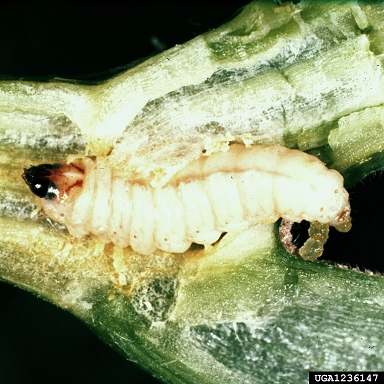
Clemson University - USDA Cooperative Extension Slide Series, Bugwood.org

Squash Vine Borer. Photo courtesy of Clemson University – USDA Cooperative Extension Slide Series, Bugwood.org

For more photos, see http://bugguide.net/node/view/11810

How can you stop this evil insect?  Everyone from Walliser to Walter Reeves says that prevention is key.  Here are the universally acknowledged methods of preventing the heartbreak of a squash vine borer infestation.

* Get a Move On.
If it is possible, rotate your crops.  Don’t plant squash in the same place for three or so years.

* Keep it Clean.
Well before you plant your first squash of the spring, make sure you have removed all of the old squash vines from your garden.  That way, any larvae still in the vines will be removed from your garden.  In late winter, till the area to expose any larvae/pupae that have settled down into the soil.  Your friendly neighborhood birds should take it from there.

* Plant Early and Often.
Plant your squash as early as the weather allows (read: as soon as your soil hits 60° F and you think that frost is unlikely).  The adult moths don’t emerge until early summer, so if you plant early enough, it’s possible that you’ll be sick of squash before the larvae launch their attack.  And plant your squash throughout the season.  Late plants may also miss the attack.

* Put Up Barriers.
There are lots and lots of recommendations, but the basic concept is the same: minimize how much space is available for the moth to lay her eggs.  Some options:

  • Mound soil over the vine to the lowest flower.
  • Wrap aluminum foil around the plant base where the stem meets the ground (note: I’ve tried this one, but perhaps I did it wrong.  Maybe I’ll try again this year.  Mama read somewhere that plastic cup “collars” would work, but they didn’t.  Perhaps the problem was in the execution.).
  • Cover plants with floating row covers when they start to vine, and remember to anchor the fabric to the ground.  Of course, you’ll have to remove the cover when the plants flower or you’ll have to hand pollinate.

* Search and Destroy.
Be on the lookout for the various stages of the squash vine borer.  Show no mercy.

  • If you see the orange and black moths flying around during the day, you’ll know it’s time to inspect the plants for eggs.
  • Whether or not you see the adults hovering in your garden, you should inspect the plants for eggs and destroy them (just wipe ’em off and crush ’em).  The eggs are, I’m told, reddish brown and are usually at the base of the stem.  Note: while you’re looking for squash vine borer eggs, you could also look for squash bug eggs and destroy them too.  You don’t want squash bugs, either—they are little squash vampires that suck the life right out of your squash plants.  Well, they suck the sap, anyway.  Squash bug eggs are usually on the underside of leaves.
  • Take a look at the stem of your plants to see if there is evidence of borers.  To me, it looks like sawdust on the vine.  This is your chance for revenge: cut open the stem, dig out the borer, and kill it.  Then cover your wounded squash vine with moist soil.

* Go Nuclear.
As a master gardener, I was taught to take an “integrated pest management” approach to insect control.  That is because 95% of bugs are good or at least benign.  We need bees and butterflies to pollinate our veggies.  We need ladybugs to kill aphids.  We need assassin bugs, praying mantises, and spiders to kill a whole mess of pests.  Most insecticides kill the good guys along with the bad guys.  And guess who bounces back first (hint: it’s not the good guys).  So I try to use insecticides as a last resort.  That said, if you can’t get the plants in early or if you always seem to be attacked by squash vine borers, you can try an insecticide.  Walter Reeves suggests either a weekly application of carbaryl powder to the base of the stems or spraying with acetamiprid.  Remember to read the directions!  And note: once the borer has entered the vine, it’s too late for the insecticide to work.  So take that into account when you’re devising your regimen.

Final Thoughts
One reader asked if she should consider removing an area of her soil and replacing it.  This proposal has some appeal—as discussed above, the pupae of squash vine borers settle down in our soil for a long winter nap.  In the spring, the pupae turn into adults and make their above-ground debut just in time for squash season.  That said, removing and replacing soil seems like an awful lot of work, particularly given that it would only stop the reader’s homegrown grubs.  In its adult form, a squash vine borer is a moth that could simply fly over to the reader’s yard and lay its eggs.  So I’m reluctant to suggest the removal/replacement approach until she has exhausted the other, less dramatic alternatives, starting with crop rotation, tilling, and preventive barriers.

Now that we’re all armed with this information, I feel much better about our chances against the squash vine borer this year.  I’ll keep you posted on my progress.  Please keep me posted on yours!

2 Comments »