Georgia Garden Girl

Garden Great in Zone 8!

Seed Starting Update

Hello, friends.  I planted my tomato seeds in late January/early February, and I promised you an update.  I hope your own seedlings are doing well.  Here is how mine are doing:

Tomato Seedlings as of February 25, 2013

Tomato Seedlings as of February 25, 2013

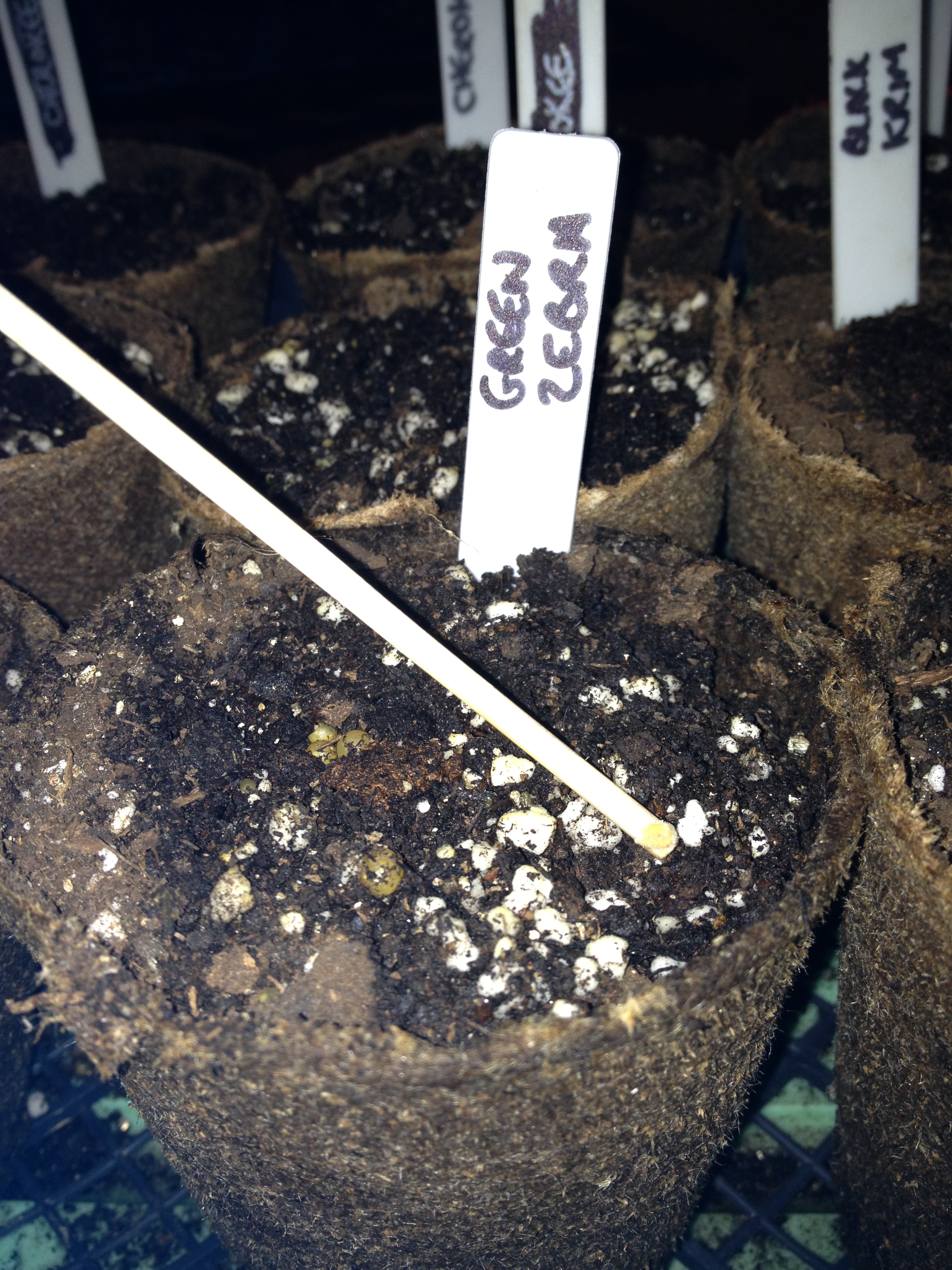
As you can see, most of them sprouted and have developed at least one set of real leaves.  Unfortunately, no Green Zebras or Sweet Millions have emerged, so I have to decide whether to plant some late seeds.  If I do (and if they actually germinate this time), then the plants will not be ready to plant outside until April.

Here is my second flat, which has tomatoes and peppers and was planted a couple weeks after the first flat:

Jack "warms" the tomato and pepper seedlings.

Jack “warms” the tomato and pepper seedlings.

My cat Jack decided that bottom shelf under the shop light/on top of the seedlings would be a great place to nap.  Oh, well.  Most of the tomatoes had barely emerged, so I did not lose any.  I’ve yet to see a pepper, which concerns me a little.  Perhaps I need to bring out the heat mat.

By the way, the local big box stores already have tomatoes!  Right now, there are not too many varieties.  I’m fairly sure that the ground is too cold for tomatoes (they need a ground temperature of 60° F), plus the weather folks predict that we will have frost this weekend in some parts of Middle Georgia.  But if you just can’t resist buying a tomato plant, at least go ahead and replant it in a gallon pot and keep it watered.  If you don’t have a cold frame, bring that baby inside on Saturday.

Happy growing!

Leave a comment »

Thou Shalt Not (Crape) Murder

Ladies and gentlemen, sharpen your clippers.  It’s time to prune in Zone 8.  Before you go to your yard and start whacking, make sure you know what needs to be pruned, what doesn’t need to be pruned, and the basics of how to prune.

The most common pruning question I get relates to the crape myrtle.  People ask, “I see that lots of people cut their crape myrtles way back.  Do I have to do that?”  I say, “Heck no!”  Horticultural experts and master gardeners refer to the practice of hacking off the top of a crape myrtle as “crape murder.”  Southern Living even has a contest to find the worst perpetrators because Steve Bender (aka SL’s Grumpy Gardener) reckons that the “best way to stop crepe murder is to humiliate the criminals by posting photos of their heinous acts on The Grumpy Gardener” website If you will promise to refrain from crape murder, I will promise not stop my car to take a picture of your landscaping and post it on the internet for all the world to ridicule.  Plus, you will not waste your valuable time on unnecessary work.

First things first, though.  I should start by explaining why to prune, when to prune, and how to prune.  Then I’ll address specific plants, including the crape myrtle.  Before I sat down to write this post, I thought it would be easy to condense this topic into an article of reasonable length.  Ha!  There are hundreds of books and articles about pruning.  I checked several books out of my local library and browsed a few others at a local bookstore, and I reviewed dozens of articles.  I was happy to discover that these sources are all very repetitive, which I suppose is good—everyone agrees on the basics.  I also realized that sometimes a drawing or picture really helps.  Given that I have removed most of the “pruning nightmare” plants from my yard, I don’t have many great examples that I can photograph, so I need to point you to someone else’s photos.  And if I tried to draw pictures it would take me so long that it would be autumn before I could publish the post, and autumn is generally not a good time to prune, so I need to point you to someone else’s drawings.  For these reasons, I decided to try to put together a clearinghouse of information, which is mostly from the following trusted sources: UGA Extension Service, Clemson Extension Service, Walter Reeves, Southern Living, Pruning Trees, Shrubs & Vines by Karan Davis Cutler (a publication of the Brooklyn Botanic Garden), Gardening in the South by Don Hastings, and Georgia Master Gardener Handbook.

Why to Prune
Safety First.
  Let’s say you’ve got a tree whose branches are unhealthy and loom precariously over your neighbor’s garage.  Prune!  Or a tree whose branches are tied up in the power lines.  Call the power company and ask it to prune (then call a line-certified tree guy when the power company says “that’s not our line”)!  Or a bush that blocks your view of the road from your driveway.  Prune!  Or a bush that invades your neighbor’s property year after year (yes, neighbor, I’m talking about that cherry laurel and privet you let creep under the fence into my vegetable garden).  Prune!

Prune for Health.  For any woody plant from a tree to a shrub, you need to get rid of damaged and dead wood.  Leaving it may promote disease.  If you do have a plant with a disease problem, make sure you sterilize your pruning tools between cuts.  Just dip the blades in rubbing alcohol or a weak bleach solution (one part bleach, ten parts water).  Remove suckers, which are sprouts that come up from the base of the tree or shrub.  Suckers only take nutrients and water away from your plant.  For trees, there are a few other guidelines for good health.  Remove branches that grow inward, branches that grow straight down, branches that cross each other, and branches that rub other branches.  Over time, branches that are permitted to rub together will wound each other and may even affect the trunk of your tree.

Keep Plants In Their Place.  I’m going to preface this one by stating what should be obvious.  If you want a small bush, plant a bush that stays small.  Why plant a Natchez crape myrtle, which will grow 20-30 feet tall, when what you really want is a bush that tops out at six feet?  Plant a Dwarf Snow instead.  And why plant a Burford holly that really wants to be 15 feet tall in front of your windows that are three feet off the ground?  If you want to be able to see out of your windows, plant a dwarf cultivar instead.  You can save a lot of time and energy by simply choosing the right plant for the site.

That said, if you’ve made some bad plant decisions or inherited some plants need to be constrained and you are reluctant to remove them, Prune!  You might even get to prune monthly!  (See above regarding Burford holly vs. windows.)  Remember, if you’re trying to constrain a plant, it’s best not to wait until the plant is already tremendous.  If you have a plant that has outgrown its space and you don’t want to do a single “ground level prune,” then you may need to work in phases so the plant will have a chance to recover—never remove more than 1/3 of the healthy growth during a growing season.  And you should know that some plants won’t recover from a severe pruning (sometimes euphemistically called “renewal pruning”)—don’t try this with boxwoods, junipers, pines, cedar, arborvitae, or yews.

Shape Up.
Whether you want a unicorn-shaped boxwood, an espaliered fig tree, or just a tidy looking row of dwarf yaupons, you’ll need to do some pruning.  I like a natural look, so I usually just try to follow the plant’s shape and take out any wacky rogue branches.  I don’t have a great spot for espaliering, so I’m not the best resource.  Visit http://www.caes.uga.edu/publications/pubDetail.cfm?pk_id=7656#Specialty to get started.  I haven’t got the patience for topiary, so you’ll need to do some independent research to achieve that unicorn.  Check out http://www.hort.cornell.edu/livingsculpture/topiary/index.htm for some basic information and resources on topiary.

Get Productive.
You can affect the productivity of your plants by pruning.  With roses, for example, if you want a lot of smaller flowers, prune lightly.  If you want a few large flowers, prune heavily.  Remember, pruning promotes vegetative growth and may delay the production of flowers and fruits.

When to Prune
The “when” of pruning depends on your hardiness zone and on the plant.  Now, you can remove dead wood any time.  But for other types of pruning, there is a “best” time to prune.  Here in Zone 8, we try not to prune our shrubs and trees during the late fall or early winter because pruning promotes new growth that may be damaged by a freeze.  We prune non-flowering shrubs, including hedges, in late winter or early spring.  And we typically follow the “May Rule” of pruning for flowering shrubs.  Under the “May Rule,” we prune spring-flowering plants that bloom before May after they bloom, and we prune summer-flowering plants that bloom in May or later in late February or early March.  So prune your azaleas, dogwoods, flowering cherries, forsythia, and winter daphne after they bloom.  Also, if you have hydrangeas that bloom only on old growth, prune them after flowering (I realize that hydrangeas bloom during after May, but this is an exception to the rule; old-school hydrangeas only bloom on the previous season’s growth.  If you’ve got Endless Summer or another newer cultivar that blooms on new wood, prune away in February).  On the other hand, prune your roses, gardenias, crape myrtles, tea olives, and camellias in the late winter, before spring growth begins.

Totally confused?  Walter Reeves developed a super helpful chart designed to help you decide when to prune each type of plant.  Check it out.  http://www.walterreeves.com/uploads/WRshrubprunning.pdf or http://www.walterreeves.com/landscaping/shrub-pruning-calendar/See also http://www.caes.uga.edu/publications/pubDetail.cfm?pk_id=6098#Time.  Another helpful resource: the Grumpy Gardener’s list of 10 Plants You Should Never Prune in Fall (Azalea; Flowering cherry, peach, plum, pear, crabapple; Forsythia; Lilac; Loropetalum; Oakleaf hydrangea; Rhododendron; Saucer or star magnolia; Spirea; Viburnum).

How to Prune
Mama had a professional horticulturist come out to her house to show her how to prune her shrubs.  He told her that she should “prune like a ballerina.”  I’m pretty sure he did not mean for her to put on a tutu and tiara.  What he meant is that for most plants, you need to follow the shape of the plant, and you should proceed gently.

First, make sure you have the equipment you will need.  Most of us need hand pruners and lopping shears.  Those of us who want to prune trees may also find it helpful to have a pole pruner.  And those of us who want to prune hedges will need some hedge shears.  For more information on pruning tools, see http://www.caes.uga.edu/publications/pubDetail.cfm?pk_id=7656#Tools.

Second, you might find it helpful to know some basic science behind pruning.  The extremely abridged CliffsNotes version is this: pruning promotes growth, and most regrowth occurs within six to eight inches of the cut.  For more information on the science of pruning woody plants, including an explanation of terminal buds, lateral buds, nodes, apical dominance, auxin, responses to pruning, etc., please see http://www.caes.uga.edu/publications/pubDetail.cfm?pk_id=6098

There are two main types of pruning.  The first type is called “heading back” or “shearing.”  With heading back, you remove the ends of the twigs and branches.  This practice encourages thick growth near the site of the cut, and the most vigorous growth will be near the cut and toward the outside of the plant.  This may sound great, but as Walter Reeves says, if you head back to just one height (as you might with power hedge clippers), “you’ll end up with an eggshell of greenery covering an interior of brownery.”  That’s because you need light to reach the interior of your plant in order to have leaves grow there.  The solution?  If you want to head back your hollies or your boxwoods, try to head back to several different heights.  And make some thinning cuts (see below) so the light can get to the inside of your plant.  Caveat: this technique will result in a less formal look.  For information on pruning hedges, see the “Hedges” section of http://www.caes.uga.edu/publications/pubDetail.cfm?pk_id=7656#Guidelines

For most plants, the preferred method of pruning is called “thinning.”  With this method, you remove the entire branch or shoot all the way back to the main trunk, limb, or branch.  This approach encourages new growth within interior portions of a shrub.  The best way to prune a tree is to cut back to the main trunk, a lateral branch, or a bud.  Never ever leave a stub!

For more information and to see some pictures of proper pruning techniques, see http://www.caes.uga.edu/publications/pubDetail.cfm?pk_id=7656#Technique, http://www.caes.uga.edu/publications/pubDetail.cfm?pk_id=6098#Types, and
http://www.clemson.edu/extension/hgic/plants/landscape/trees/hgic1003.html.

Pruning Trees
Improper pruning is the second leading cause of tree death (construction damage is the first).  The most important rule of tree pruning: do not top trees.  In other words, never cut branches back to stubs like the crape murderers do.

Crape Murder in Midtown Columbus

Crape Murder in Midtown Columbus

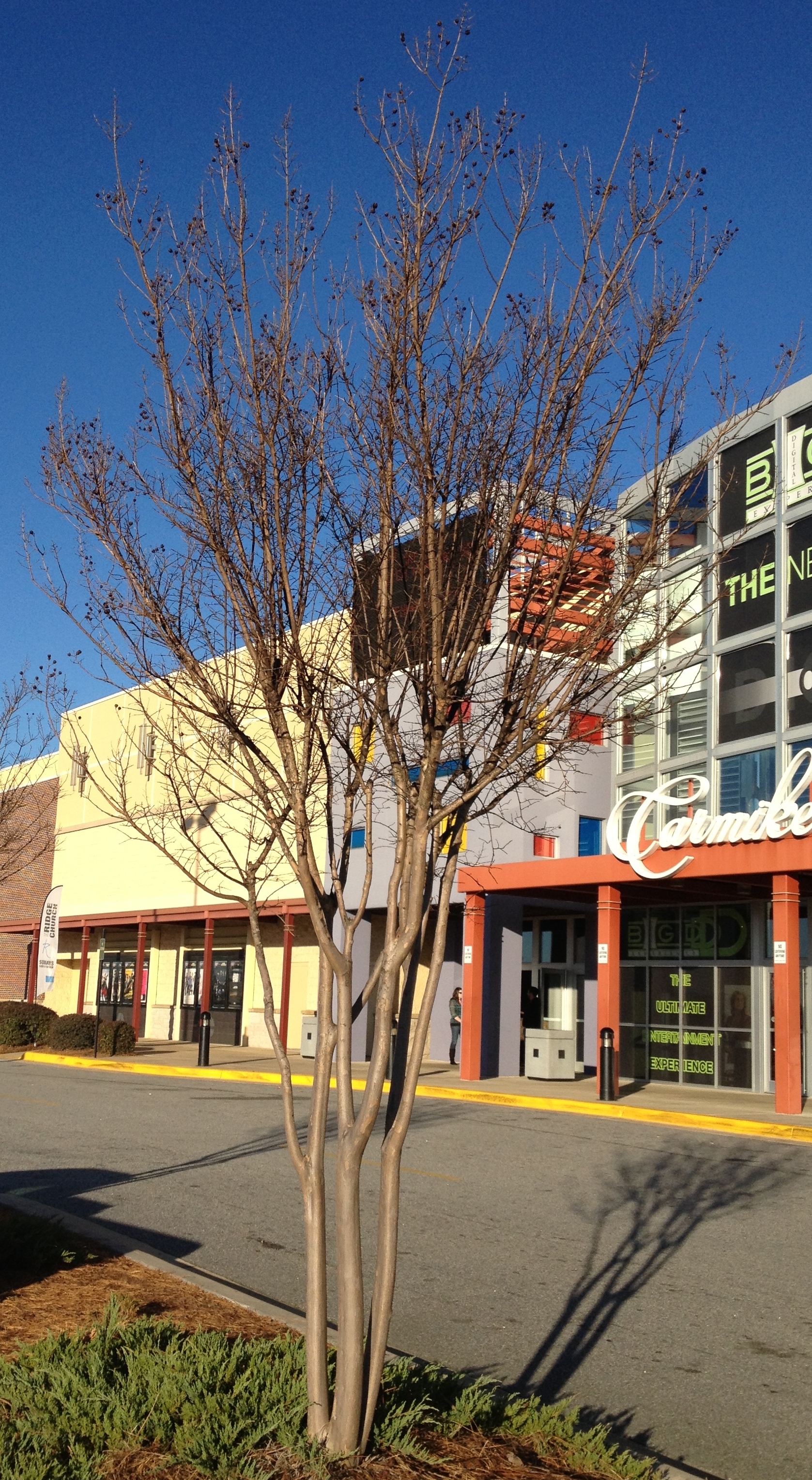
Not Crape Murder

Good job, Carmike! Thanks for not crape murdering!

Why not?  Topping produces a ton of new shoots just below each cut—the tree has to replace all the leaf area it just lost.  The shoots are not strong like the old branches, and they are prone to breaking.  Topping also destroys the natural branching structure of a tree, and it actually makes the tree more top-heavy and prone to wind damage.  And topping opens the tree to decay, infection and insect infestations.  For example, crape myrtles that are topped are far more susceptible to powdery mildew than crape myrtles that are properly pruned.  So what do you do if you think your tree is too tall for its space and you don’t want to take it down?  Thin the tree by removing branches back to their point of origin.  Cut branches back to a strong lateral branch, to the parent limb, or to the trunk itself.  If you’re in doubt about the best way to prune your tree to reduce its height, you may want to consult an arborist.

There are several other important rules of thumb for tree pruning.
* Never remove more than 25% of the foliage in one year.
* Do not paint the pruned area of a tree.  Just do a good cut.  And do it in the spring if possible, when wound closure is fastest.
* How do I make a good cut, you ask?  Well, you want the cut to be as close to the trunk as possible.  Most tree folks recommend the “three-cut” approach.  First, you want to make a notch on the bottom of the branch—the notch should be several inches from where the branch meets the trunk.  Second, cut through the limb from the top, a little farther from the trunk than the notch you just made.  Third, remove the remaining stub by cutting just outside the branch collar.  For a picture of the proper three-cut technique, see http://www.caes.uga.edu/publications/pubDetail.cfm?pk_id=6098#Types (Figure 8(b)).  For more information on tree pruning in general, see http://www.clemson.edu/extension/hgic/plants/landscape/trees/hgic1003.html.

Crape Myrtle
With this information in mind, I can now explain how not to commit crape murder.  First of all, for a large old crape myrtles in tree form, there’s just no reason to do much pruning.  Just remove dead wood and suckers, and you should be good to go.

There are, however, times when you may need to prune a crape myrtle.  If you need to prune, do it in late winter (late February is a great time).  If you’ve got a baby crape myrtle and you want to make sure you are encouraging a tree shape, select between three and five nicely spaced shoots as the main trunks and cut out the rest.  Remove the side branches from the bottom half of the shoots.  And remove suckers.  As the crape myrtle continues to grow, you will want to continue to remove the lower branches so that your canopy starts between three and four feet above ground level.

Now, if your crape myrtle is growing up into the roof of your porch, I’m sad to say that it’s just plain in the wrong place—it should have been planted farther from the house.  Bless your pour little heart.  You can try to thin the tree.  Another option: you can try growing your crape myrtle as a shrub.  According to the UGA extension, a crape myrtle will grow as a compact shrub if you prune the stems back to approximately six inches above ground level each year.  For an “intermediate size” crape myrtle shrub, prune by removing growth smaller than a pencil.  Don’t cut large limbs or leave stubs!  For more information on pruning crape myrtles, please see http://www.caes.uga.edu/publications/pubdetail.cfm?pk_id=6861#Pruning and http://thedailysouth.southernliving.com/2009/02/24/what-concerns-p/.

Other Trees
Most trees, including ornamental flowering trees, hardly ever need pruning.  Just prune dead or diseased wood, and prune suckers.  You may also need to prune rubbing or crossing branches (for flowering trees, do this after flowering).  For more information, see http://www.caes.uga.edu/publications/pubDetail.cfm?pk_id=7656#Guidelines (Sections on Deciduous Shade and Flowering Trees and Broadleaf Evergreen Trees).  For an article on general care of ornamental cherry, plum, apricot, and almond trees, see http://www.clemson.edu/extension/hgic/plants/landscape/trees/hgic1018.html.

Fruit trees are an exception to this general rule.  Pruning and training are especially important for young fruit trees.  For information on pruning fruit trees, see generally http://www.walterreeves.com/food-gardening/pruning-fruits-and-fruit-trees/

See also:
Apple
http://www.caes.uga.edu/publications/pubDetail.cfm?pk_id=6364#Pruning
http://www.clemson.edu/extension/hgic/plants/vegetables/tree_fruits_nuts/hgic1351.html
Fig
http://www.caes.uga.edu/publications/pubDetail.cfm?pk_id=6802#Train
Peach
http://www.caes.uga.edu/publications/pubDetail.cfm?pk_id=6365#Training
http://www.clemson.edu/extension/hgic/plants/vegetables/tree_fruits_nuts/hgic1355.html
Pear
http://www.caes.uga.edu/publications/pubDetail.cfm?pk_id=6366#Handling
http://www.clemson.edu/extension/hgic/plants/vegetables/tree_fruits_nuts/hgic1351.html


Pruning Shrubs
In this section, I’ve listed some of the most common shrubs grown in Zone 8 and given a short explanation on when and how much to prune each plant.  If possible, I’ve included a link to a fact sheet on the shrub.  For more plants/information, see http://thedailysouth.southernliving.com/2011/05/09/can-i-prune-it-now-grumpy-cuts-to-the-chase/.

Azaleas
.  Prune in the spring after the plant flowers, and only if necessary.  Do not prune if the azalea looks good.  See http://www.caes.uga.edu/publications/pubDetail.cfm?pk_id=7732#Maintenance.

Beautyberry.  Prune in late winter/early spring to thin out the plant prior to spring growth.  Avoid fall or winter pruning.  You can cut back pretty hard because beautyberry flowers and fruits on new growth.  See http://www.clemson.edu/extension/hgic/plants/landscape/shrubs/hgic1086.html.

Blackberries.  Make sure you know what kind of plant you have.  Most blackberries have a biennial cycle, and they fruit on last year’s growth.  So after the plant fruits, you should only cut out the canes that fruited this year (they’ll probably look dead, anyway).  But do not cut out the new vegetative growth.  Now, if you have “primocane” blackberries, they fruit on first-year growth, so in winter you can cut off all the canes.  For more information, see www.caes.uga.edu/publications/displayPDF.cfm?pk_ID=6371;
http://www.walterreeves.com/gardening-q-and-a/blackberries-and-raspberries-fruit-growth/.

Blueberries.  If you’re growing rabbiteye blueberries (the kind that do best in Zone 8—they’re actually native to Georgia), you won’t need to prune much except when you plant the bushes.  When the bushes reach four to six feet in height, you’ll want to start a “cane renewal program” and prune between one and three of the largest canes back to 24 inches or less.  Prune in late winter.  See http://www.caes.uga.edu/publications/pubDetail.cfm?pk_id=6793.

Boxwood.  Prune in spring or summer.  Please don’t prune when it’s freezing.  Boxwood will not likely tolerate a severe prune, so don’t ever reduce by more than 25% at a time.  Remember to do some thinning cuts so that light and air can reach the interior of the plant.  See http://www.walterreeves.com/gardening-q-and-a/boxwood-pruning/.  Please note: Walter Reeves says that power hedge trimmers “are the devil’s tool when it comes to boxwoods.”  Also note: what you think is a boxwood may actually be a holly.  To tell for sure, pinch a small twig.  If the buds are directly opposite each other, then you’ve got a boxwood.  If the buds are not directly opposite but are, instead, “alternate,” you’ve got a holly.

Butterfly Bush.  Prune in late winter/early spring to thin out the plant prior to spring growth.  Avoid fall or winter pruning.  According to Clemson, “pruning butterfly bushes to within one foot of the ground annually enhances the flower display.”  See http://www.walterreeves.com/gardening-q-and-a/butterfly-bushes-pruning-2/

Camellia.  Important note: Camellias require very little pruning.  They also grow very slowly, so they don’t recover quickly from pruning.  I don’t understand why folks waste time shearing them into orbs.  They have a round growth habit anyway.  That said, you can cut back the wild shoots to maintain shape.  You can also control the growth of camellias using thinning cuts.  For sasanquas, which bloom in the fall, wait until late winter/early spring to prune.  For japonicas, which bloom in the winter, wait until after they bloom to prune.  You can cut out dead or weak stems any time.  http://www.clemson.edu/extension/hgic/plants/landscape/shrubs/hgic1062.html.

Elaeagnus.  Grumpy Gardener says that the best time to prune elaeagnus is “any time you have a chainsaw.”  I second that emotion.  I would also add that you may need a stump grinder in addition to your chainsaw.

Gardenia.  Prune in late winter/early spring to remove straggly branches.  You can also prune in the summer after the flowers turn brown and begin to drop.  Do not prune in late fall.  See http://www.walterreeves.com/landscaping/gardenia-when-to-prune/.

Holly.  Most evergreen hollies will tolerate a pretty severe prune, and they can be pruned most any time.  If you have a holly that produces berries that you like, prune in winter before spring flowering.  If you don’t care about the berries, you can prune just about any time during the growing season (late winter and early spring are always good times).  Remember—the holly will branch where you cut it.  Many of us use hollies in hedges.  For information on pruning hedges, see the “Hedges” section of http://www.caes.uga.edu/publications/pubDetail.cfm?pk_id=7656#Guidelines.

Hydrangea.  With hydrangeas, you need to know what kind you have.  Bigleaf, French, and Oakleaf hydrangeas bloom on old wood, which means that you should prune after flowering.  Peegee and smooth hydrangeas bloom on new wood and can be pruned back in late February or early March (if you prune back severely, you’ll get huge flowers but not a ton of them).  For information on hydrangea identification and pruning, see http://www.walterreeves.com/landscaping/hydrangea-identification-and-pruning/.  You may also want to read “Why Your Hydrangea Didn’t Bloom.”

Loropetalum.  Prune in March after the plant flowers.  If your loropetalum is very overgrown, you may want to replace it with a smaller cultivar if you don’t want to prune several times a year.  http://www.walterreeves.com/gardening-q-and-a/loropetalum-pruning/ and http://www.walterreeves.com/gardening-q-and-a/loropetalum-bush-pruning/

Muscadines.  Prune in February or early March.  See http://www.caes.uga.edu/publications/pubDetail.cfm?pk_id=6826.

Oleander.  Prune just prior to spring growth; oleander flowers on new growth.  In my experience, it’s best to wait until you’re pretty sure you will not have a frost.  So mid-March or so.  Always be careful with oleander.  It is one of the most toxic ornamental plants in the Southeast.

Pyracantha.  Grumpy Gardener says that pyracantha will eat your house if you don’t keep it pruned.  The best time to prune pyracantha is after flowering/fruit sets so you can make sure you’ll have berries in the fall (berries are only produced on old wood).  WEAR THICK GLOVES.  See http://www.walterreeves.com/gardening-q-and-a/pyracantha-pruning/.

Roses.  Prune hybrid teas, grandifloras, and floribundas in early spring when new growth begins.  Prune climbing and old garden roses roses after flowering.  See http://www.clemson.edu/extension/hgic/plants/landscape/flowers/hgic1173.html.

Knockout Roses.  Prune knockout roses in late February or early March.  See http://www.walterreeves.com/gardening-q-and-a/knockout-rose-how-low-to-prune/.

Whew!  I know you’re tired if you’ve stuck with me to the bitter end here—thank you, thank you.   Now I will have a glass of wine, listen to the rain, and peruse the new issue of Southern Living that arrived today.  Have fun with your pruning projects, and be safe!

1 Comment »

Columbus Arbor Day Event Canceled

I just got word that due to the glorious rain, the Arbor Day celebration in Columbus will not be held tomorrow, February 23, as previously scheduled. I’ll let you know when I hear about a new date.

Leave a comment »

An Apostrophe Epidemic

Please allow me to digress from the topic of gardening for one short article.  Aunt Emmie and Goggy, this one’s for you.

Is it just me, or are we in the middle of apostrophe epidemic?  Everywhere I look, someone misuses this punctuation mark, and it seems to me that apostrophe mistakes are reaching epidemic proportions.

There are plenty of other grammar and punctuation problems that occur with epidemic frequency, much to the horror of my grandmother and aunt.  There is the ending-sentences-with-prepositions epidemic; it is now apparently acceptable for college professors and newscasters to ask where something “is at.”  There is the use-of-the-wrong-pronoun epidemic; some folks don’t even blink when a college graduate says, “Her and I went to the store” or “George came to the community garden with Martha and I.”  Don’t get me wrong—I do find these slip-ups in the spoken word to be quite irritating.  But these days, it is glaringly obvious apostrophe mistakes that irk me most.  Aren’t we supposed to spend at least some time thinking about what to write and how to punctuate it?

My writing is far from perfect.  I know that.  I am sure that I make my share of mistakes.  I usually experience a conjugation conundrum when it comes to the verbs “lay” and “lie.”  I overuse dashes, semicolons, parentheticals, and footnotes.  I have arguments with colleagues about the proper placement of commas.  I occasionally start sentences with “however.”  But I rarely misuse the apostrophe.

The rules of the apostrophe are simple and finite.  Why are so many people confused by this tiny speck of punctuation?  Maybe we text so much that we’ve forgotten how to write using real words and punctuation.  Or maybe we’ve seen so many examples of poor punctuation in websites, work documents, and (gasp) newspapers that we are desensitized to the problem. But we can still try to get the apostrophe right.  Friends, you don’t need to whip out The Elements of Style every time you want to use an apostrophe.  (But if you’re curious, the apostrophe is addressed on page 1.)  Just try to remember the basic rules.  And remind your friends!  Let’s review.

1. Do not use an apostrophe to make a plural.  This mistake the most common one, and it is on the rise.
Incorrect: “Elizabeth was upset that her neighbor’s trampled her zinnia’s.”
No, no, no!  No apostrophes are necessary in this sentence.
Correct: “Elizabeth was upset that her neighbors trampled her zinnias.”
Think back to elementary school, when you learned that plurals of nouns are typically formed by simply adding an s or, in some cases, by adding es.  I know your third grade teacher did not tell you to add an apostrophe.  Resist!
2. Do not use “it’s” when you mean “its” (and vice versa).  This is the first of what I call the homonym mistakes, and it is terribly common.
Incorrect: “Its a shame that the dog couldn’t find it’s bone.”
Correct: “It’s a shame that the dog couldn’t find its bone.”
Remember, “it’s” is a contraction of “it is” or “it has.”  “Its” is a possessive pronoun for it.  While we do use apostrophes to create possessives, we do not use apostrophes to create possessive pronouns.  Just as you wouldn’t write “her’s” instead of “hers” or “your’s” instead of “yours,” you should be careful not to write “it’s” instead of “its.”  When in doubt, spell out “it is” and don’t use a contraction.
3. Do not use “your” when you mean “you’re” (and vice versa).  This mistake is similar to the “it’s” vs. “its” mistake.  For some reason, it is even more annoying.
Incorrect: “Your supposed get you’re trowel so that you can plant the pansies.”
Correct: “You’re supposed to get your trowel so that you can plant the pansies.”
“You’re” is a contraction of “you are.”  “Your” is the possessive of the pronoun you.  When in doubt, spell out “you are” and don’t use a contraction.
4. Punctuate the possessive plural properly.  We’re going to step away from the homonym mistakes for a moment.  Don’t worry.  We’ll get back to them soon.  But first, we are going to have a brief refresher course on the possessive plural.  Church bulletin editors and invitation issuers everywhere, please take note.  Let’s say the potluck supper is at the home of Mary and Joseph Gilbert.  If you want to make the plural possessive of “Gilbert,” just add s and an apostrophe.
Correct: “The potluck supper is at the Gilberts’ house.”
Incorrect: “The potluck supper is at the Gilbert’s house.”
On the other hand, if you want to use the couple’s first names, you would add ’s to the second name.  So, “The potluck supper is at Mary and Joseph’s house.”  Simple, right?
Now, let’s say that the Bible study is at the home of Naomi Jones and her daughter-in-law, Ruth.  If you want to make the plural possessive of “Jones,” add es and an apostrophe.
Correct: “The Bible study is at the Joneses’ house.”
Incorrect: “The Bible study is at the Jones’ house.”
Also Incorrect: “The Bible study is at the Jones’s house.”
Again, you could always say that the Bible study is at “Naomi and Ruth’s house.”
5. Punctuate the possessive singular properly.  If you have a friend or relative named James or Charles (or something else that ends in an s), listen up.  Form the possessive singular of a noun by adding ’s—no matter what the final consonant is.  It’s “James’s toy” and “witch’s broom.”  There are exceptions, of course, like the possessive of ancient proper names ending in –es and –is.  So it’s “Jesus’ prayer” or “Achilles’ heel.”  When in doubt, consult Messrs. Strunk and White.
6. Do not use “there” or “their” when you mean “they’re.”  Another common homonym mistake!
Clearly nonsensical: “Their going to plant there annuals over they’re.”
Correct: “They’re going to plant their annuals over there.”
“Their” is the possessive of the pronoun they.  “They’re” is a contraction of “they are.”  And “there” is a place that is not here.
7. Do not use “whose” when you mean “who’s” (and vice versa).  I think this is the last of the most common homonym mistakes.
Incorrect: “Who’s shovel is this, and whose the one who offered to sharpen it?”
Correct: “Whose shovel is this, and who’s the one who offered to sharpen it?”
“Whose” is the possessive of the pronoun who.  Who’s is a contraction of “who is” or “who has.”

Thank you for letting me ramble about the apostrophe.  I realize that the apostrophe epidemic is insignificant compared to all the other epidemics we face (obesity epidemic, flu epidemic, epidemic of incivility, etc.).  But the basic rules of the apostrophe are so easy that we need not suffer from an apostrophe epidemic!  Thank you for your attention to this matter.  And please don’t get me started on “alot” and split infinitives.  I’ll get back to gardening now.

Leave a comment »

My Evil Nemesis: The Squash Vine Borer

I have an evil nemesis.  It is not the mean girl from church who told me during middle school that I must be stupid because I went to public school.  It is not the smokers who seem to view the sidewalk in front of my house as their drive-by ashtray.  It is not the folks who thought it was a good idea to let a chinaberry tree grow in my yard (this was not a good idea; chinaberries are quite invasive and should not be used in Southern yards on purpose).  It is not even a person.  My evil nemesis is an insect called the squash vine borer.  I’m not alone—several readers have expressed concern about the squash vine borer, and I will try to answer your questions in this post.

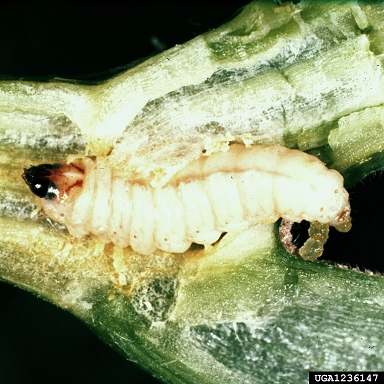
The squash vine borer (Melittia satyriniformis or Melittia cucurbitae) wreaks havoc on squash and gourd plants.  As Jessica Walliser notes in her excellent book entitled Good Bug, Bad Bug, “Unfortunately, most gardeners don’t notice borer damage until it’s too late.”  In other words, if a squash vine borer attacks your garden, you have a beautiful zucchini plant one day and a wilted mess of sadness the next.  To you, it may seem to happen overnight, but this horticultural murder is definitely premeditated.  What happens is this: one day in late May, a black and orange moth that looks kind of like a wasp emerges from her cocoon.  She meets a boy moth.  One thing leads to another, and the girl moth lays some eggs on the vine of your squash plant.  The eggs hatch, and some little white larvae emerge.  Don’t be fooled by their diminutive size; the larvae are killers, and your squash plant is their all-you-can-eat buffet.  The larvae bore their way into the stem and feast on the flesh, killing the plant from the inside.  Your plant dies, you cry, and then you notice the tell-tale sawdust-like residue at the base of the vine, and you clench your fists and yell to the heavens, “why, why, why?”  (At least that’s my reaction.)  Then the larvae, finally finished with their gluttonous rampage, settle down into the soil as pupae.  When spring arrives, they undergo a metamorphosis and turn into the aforementioned black and orange moth.  And so the cycle continues.

Clemson University - USDA Cooperative Extension Slide Series, Bugwood.org

Squash Vine Borer. Photo courtesy of Clemson University – USDA Cooperative Extension Slide Series, Bugwood.org

For more photos, see http://bugguide.net/node/view/11810

How can you stop this evil insect?  Everyone from Walliser to Walter Reeves says that prevention is key.  Here are the universally acknowledged methods of preventing the heartbreak of a squash vine borer infestation.

* Get a Move On.
If it is possible, rotate your crops.  Don’t plant squash in the same place for three or so years.

* Keep it Clean.
Well before you plant your first squash of the spring, make sure you have removed all of the old squash vines from your garden.  That way, any larvae still in the vines will be removed from your garden.  In late winter, till the area to expose any larvae/pupae that have settled down into the soil.  Your friendly neighborhood birds should take it from there.

* Plant Early and Often.
Plant your squash as early as the weather allows (read: as soon as your soil hits 60° F and you think that frost is unlikely).  The adult moths don’t emerge until early summer, so if you plant early enough, it’s possible that you’ll be sick of squash before the larvae launch their attack.  And plant your squash throughout the season.  Late plants may also miss the attack.

* Put Up Barriers.
There are lots and lots of recommendations, but the basic concept is the same: minimize how much space is available for the moth to lay her eggs.  Some options:

  • Mound soil over the vine to the lowest flower.
  • Wrap aluminum foil around the plant base where the stem meets the ground (note: I’ve tried this one, but perhaps I did it wrong.  Maybe I’ll try again this year.  Mama read somewhere that plastic cup “collars” would work, but they didn’t.  Perhaps the problem was in the execution.).
  • Cover plants with floating row covers when they start to vine, and remember to anchor the fabric to the ground.  Of course, you’ll have to remove the cover when the plants flower or you’ll have to hand pollinate.

* Search and Destroy.
Be on the lookout for the various stages of the squash vine borer.  Show no mercy.

  • If you see the orange and black moths flying around during the day, you’ll know it’s time to inspect the plants for eggs.
  • Whether or not you see the adults hovering in your garden, you should inspect the plants for eggs and destroy them (just wipe ’em off and crush ’em).  The eggs are, I’m told, reddish brown and are usually at the base of the stem.  Note: while you’re looking for squash vine borer eggs, you could also look for squash bug eggs and destroy them too.  You don’t want squash bugs, either—they are little squash vampires that suck the life right out of your squash plants.  Well, they suck the sap, anyway.  Squash bug eggs are usually on the underside of leaves.
  • Take a look at the stem of your plants to see if there is evidence of borers.  To me, it looks like sawdust on the vine.  This is your chance for revenge: cut open the stem, dig out the borer, and kill it.  Then cover your wounded squash vine with moist soil.

* Go Nuclear.
As a master gardener, I was taught to take an “integrated pest management” approach to insect control.  That is because 95% of bugs are good or at least benign.  We need bees and butterflies to pollinate our veggies.  We need ladybugs to kill aphids.  We need assassin bugs, praying mantises, and spiders to kill a whole mess of pests.  Most insecticides kill the good guys along with the bad guys.  And guess who bounces back first (hint: it’s not the good guys).  So I try to use insecticides as a last resort.  That said, if you can’t get the plants in early or if you always seem to be attacked by squash vine borers, you can try an insecticide.  Walter Reeves suggests either a weekly application of carbaryl powder to the base of the stems or spraying with acetamiprid.  Remember to read the directions!  And note: once the borer has entered the vine, it’s too late for the insecticide to work.  So take that into account when you’re devising your regimen.

Final Thoughts
One reader asked if she should consider removing an area of her soil and replacing it.  This proposal has some appeal—as discussed above, the pupae of squash vine borers settle down in our soil for a long winter nap.  In the spring, the pupae turn into adults and make their above-ground debut just in time for squash season.  That said, removing and replacing soil seems like an awful lot of work, particularly given that it would only stop the reader’s homegrown grubs.  In its adult form, a squash vine borer is a moth that could simply fly over to the reader’s yard and lay its eggs.  So I’m reluctant to suggest the removal/replacement approach until she has exhausted the other, less dramatic alternatives, starting with crop rotation, tilling, and preventive barriers.

Now that we’re all armed with this information, I feel much better about our chances against the squash vine borer this year.  I’ll keep you posted on my progress.  Please keep me posted on yours!

2 Comments »

Celebrate Arbor Day in Columbus!

I’m sorry it’s been so long since my last post!  It’s been busy at work and with site visits.  Mama cashed in on her Christmas present (two days of yard work), so I had to do that. Plus, my sister had a new baby girl, so of course I had to go visit, and I am smitten.  Isn’t she the most precious thing?
EAM 20130201
Enough excuses!  It’s back to work with an important announcement. Next Saturday, Keep Columbus Beautiful and the Urban Forestry and Beautification Division will celebrate 35 years of Columbus Georgia as a Tree City USA.  There will be tree walks, bucket truck rides, free tree seedlings, interactive nature activities, environmental exhibits, and much more!  Country’s BBQ will be on site, and the The Girl Scouts of Historic Georgia will be selling Girl Scout cookies.  Don’t miss out on the fun and fellowship!
Where: Lakebottom Band Shelter, Cherokee Ave., Columbus GA
When: Saturday, February 23, 2013, 11:00 am-1:00 pm
Contact the Keep Columbus Beautiful Commission office for more details. 706-653-4008.

Leave a comment »

The Scoop: How (Not) to Dispose of Your Dog’s Waste

This week’s article was going to be about proper pruning techniques.  But when I went to Target after church today, my conversation with the friendly cashier led me to the exciting topic of dog waste.  We have at least three weeks before we need to start pruning here in Middle Georgia, so pruning can wait.  Just don’t prune anything now (unless you’re cutting out some dead wood.  That’s fine).

So there I was at Target.  I only had two items, so I told the friendly cashier that I did not need a bag.  The cashier seemed concerned.  Cashier: “Are you sure?”  Me: “Yes.” Cashier: “Really?  You can use them again.  I use the bags for my dog.”  Okay.  So far, this makes sense.  I told the cashier that I like to use the biodegradable pick-up bags because they’re biodegradable and usually hole-free.  He replied, “Oh.  I use puppy pads for my dog.  I just trained him to go on the puppy pads.  Then I put the whole thing in the bag.  It’s a lot less work.”  Hmmm.  A lot less work than taking the dog outside to do his business?  “Yes!  The puppy pads aren’t just for one-time use.  I only have to clean it up once in a while, and I don’t have to walk my dog all the time.”  Um, GROSS.  I could see that it would be futile to attempt further discussion, so I said thank you, took my receipt and my two items, and left.  I figure it’s his journey if he wants to have a bored dog and a mess in his house.  But I don’t, and I’ve spent a good bit of time trying to figure out the best way to dispose of dog waste, and today I’ll share that saga with you.

A year after I bought my house, I got my very first puppy, Clementine.  She was the runt of the litter.  A tiny, sweet, precious little thing.  Well, relatively tiny.  Tiny for a Great Dane puppy.

100_2222

Clementine at 6 weeks.

As Clementine grew, so did her poop.  So what was I supposed to do with it?

CLC - YOTM 201106_2

Clementine all grown up.

Initially, I tried picking up the poop with a pooper scooper and flushing it down the toilet.  This was not an easy task, and there were a lot of potential pitfalls that made the job hazardous and unsanitary, so that idea was short-lived.  I realized that it would be a bad idea to leave Clementine’s land mines all over the yard, so I decided to do some research.  Could I use it in the garden?  Quick answer: heck, no.

The basics.  You should remove pet waste from your yard (well, from anywhere your dog poops) because it contains bacteria that can contaminate your local waterways and cause diseases in humans.  See, e.g., http://gardening.wsu.edu/stewardship/compost/petpoop.htm.  Nonetheless, I have read some internet articles that advocate composting pet waste.  Some articles say that doggie compost can even be used in a vegetable garden, but other articles suggest that it should not be used on vegetables because the compost does not heat up enough to kill pathogens like E. coli.  What do my trusted experts say?  The UGA extension service says, “Do not use human or pet feces [in your compost pile] because they may transmit diseases.”  Clemson’s extension service and Walter Reeves agree, and they are unequivocal about it: do not put pet waste in your compost bin if you will be using that compost in your garden or landscape.  So that’s it.  No Clementine waste in the compost bin.

In my research, I came across the Doggie Dooley Pet Waste Disposal System.  It’s basically a mini septic tank for your dog’s waste.  The instructions sounded pretty easy: “Just dig a hole, drop in the Doggie Dooley, add water and the Waste Terminator Digester Powder, and your system is ready to go.”  It even has a foot-operated lid opener.  Sweet!  I was convinced.  I ordered the larger steel “silver” model that is intended for two large or four small dogs (I figured that if the XL dog clothes at the pet store are for dogs under 70 pounds, my 130-pound dainty princess would be considered giant—therefore two large dogs).

When the Doggie Dooley arrived, I learned that the instruction “just” to dig a hole was a tad deceiving.  Really, you need to dig a hole that is 14 inches wide and four feet deep.  The instructions suggested that if it is not possible for you to use a post hole digger, you should use a “garden spade.”  I did not have a suitable garden spade for such a project, so I went and purchased a post hole digger (what a fabulous tool!  I now use it all the time.).  It took some effort, but I dug my 14 inch by four foot hole and dropped in the Doggie Dooley so that only the shoulder flange and the lid were above ground.  So far, so good.  I followed the remaining start-up instructions and then began depositing Clementine’s nuggets in the Doggie Dooley.

The Doggie Dooley itself is 16 inches tall – it has a tank that holds the dog waste, and the manufacturer claims that the system breaks down that waste with the enzymes and bacteria in the “Waste Terminator Digester Powder.”  When you add water, the treated liquid goes through the built-in overflow tube and into the hole below the unit, where it will seep into the ground.  One caveat: you have to make sure that you’re just depositing dog waste.  I was fairly confident the digester powder would not prevail against some of the nuggets Clementine produced during her sock-eating phase, so I did just bag those and throw them in the trash.

The system seemed to work well for a while, but then I noticed that when the water overflowed from the overflow tube, it did not look very deep.  Either the treated liquid was not percolating through the ground or the hole below the Doggie Dooley had caved in.  I decided to extract the Doggie Dooley to investigate.  I did have sense enough to refrain from adding water for about a week before the extraction, but it was still not a pretty task.  Don’t worry.  I wore gloves, long sleeves, safety goggles, and a mask.  When I dug up the Doggie Dooley, I learned that one of my theories was correct: the hole had caved in.  I have fairly loose, sandy soil, which has been great for my garden but is apparently not ideal for the Doggie Dooley.

I decided to come up with a way to reinforce the hole underneath the Doggie Dooley, but I needed some back-up.  Enter my parents.  Daddy and Mama are smart people, and they are both very handy.  The three of us concurred that we needed something like a “stent” to hold up the sides of the hole.  But what could we use?  We were unable to find a 14-inch diameter pipe, so we decided to look for a round trash can.  Unfortunately, we did not find a tall trash can with a 14-inch diameter, so we settled on a 20-gallon galvanized steel trash can (diameter = 24 inches, height = 29 inches).  We had to cut a hole in the thing.  For this project, Daddy bought me a jigsaw.  Then Daddy remembered the time in sixth grade when I injured my finger by sewing right over my fingernail with the sewing machine.  He also remembered the more recent time when I cut my finger while trying to pit an avocado (three stitches!).  Therefore, Daddy determined that I should not have any part in actually cutting the hole in the trash can.  Mama and Daddy took turns and did a beautiful job of cutting a hole in the bottom of the trash can, and they decided to cut a hole in the top, as well, so that the top of the hole for the Doggie Dooley would be reinforced.  Mama and I dug a bigger hole, buried the trash can, and re-installed the Doggie Dooley.

The Doggie Dooley worked great for several months.  The bacteria in the system appeared to be happily digesting Clementine’s waste and then the treated liquid went into the ground.  No odor, no mess.  But then I noticed a problem.  The shoulder flange, which is made of plastic, began to crack, and I decided that I should probably stop making deposits.  I’m so glad I did.  Slowly but surely, the shoulder flange cracked all the way around, and the Doggie Dooley fell right in the hole (which, BTW, was not nearly as deep as it had been initially).  That was the end of the Doggie Dooley.

I was able to extract the Doggie Dooley and dispose of it without a lot of hassle, but I had that darn galvanized trash can still in the ground.  And that thing was not coming out of the ground without a fight.  I dug around it and pulled and pulled and pulled.  Mama tried to help.  Even the handyman was stumped.  In all, I tried for at least a year to get that trash can out of the ground.  Finally, when I had local horticulturist Dewayne Gallatin help me with a landscaping project, his excellent team was able to remove the trash can.  Thank you, Dewayne.

Now, it is possible that the Doggie Dooley is a great idea if you have the right soil.  My sandy soil was not conducive to the Doggie Dooley, and the manufacturer specifically warns that it will not work in clay.  I now realize that I should have done a little more research on the Doggie Dooley system before purchasing it.  According to Walter Reeves, Larry West of UGA hypothesized that the system would not really work unless the “Waste Terminator Digester Powder” is actually a magic potion.  And Walter Reeves himself warns that it may just be a bad idea because of the danger of flooding or improper installation.  Oh, well.

After the epic fail of the Doggie Dooley, I tried burying the poop.  But my yard is not that big, and I quickly ran out of burial sites.  Now, I tend to make sure that Clementine poops when we’re on a walk in the park.  I just pick up her poop in a biodegradable plastic bag and deposit it in a park trash can.  That is what Walter Reeves says to do, anyway.  But if you have other suggestions (that are backed by good research), I’m certainly open to them.

7 Comments »

Seed Starting 101

It is finally time.  When the trees in middle Georgia start to wake up from their winter naps, it is time for me to get started on my spring/summer vegetable and flower seeds.  Hooray!

I like growing plants from seed for two main reasons.  First, it’s cheaper.  I can buy an entire packet of tomato seeds for less than the cost of a plant, and my zinnia seeds are free to me because I save them.  Yes, I had to spend some start-up money on my seed starting set-up, but in the long run I’m saving money.  Second, I get more variety.  By starting plants from seed, I can have flowers and vegetables that are not available at my local garden center.  Let’s face it, people, variety is the spice of life.  No offense to all you “boy” and “girl” fans (Big Boy, Early Girl), but I’d prefer a Cherokee Purple or a Black Krim any day.  Now I’m daydreaming about a Black Krim on white bread with Duke’s mayonnaise and a little salt and pepper.  Yum.  But I have no Black Krims right now—I need to plant some seeds so I’ll have some in May.

Before I dig in, I need to review my plan.  Last week, I figured out which of my vegetables are direct sow and which need to be started indoors.  See It Helps to Have a Plan.  The vegetables I plan to start inside and transplant are tomatoes, eggplant, okra, and peppers.  I’m going to start with the tomatoes because they can be started six to eight weeks before the last frost date.  I’ll start the rest in a couple weeks.  The only flowers I plan to start inside are my vincas, and those can be started now because I want to transplant them to my flower beds in late March.

The Set-Up
I have a pretty decent set-up in my laundry room for starting seeds:

0 Shelves

What’s so great about it?
Temperature.  The laundry room stays relatively warm.  Seeds and seedlings do best if they are in a warm (70° to 80°) environment without a lot of drafts.  I’ve never found it necessary to have a heat mat in the laundry room, but the folks at Fine Gardening recommend a heat mat, and it’s a good idea if you don’t have another option for regulating the temperature.  I’ve heard of people putting seedlings on top of the refrigerator, but (a) I store my cookbooks there and don’t want to move them, and (b) it would be tacky to install a shop light in the kitchen.
Light Source.  Seedlings need a lot of light to grow strong and stocky.  Without enough light, seedlings will be leggy, spindly, and sad.  The window in my laundry room faces north and is not terribly great, which means that I cannot take the cheapest route and use the sun as my light source.  Alas, I do not have a large, unobstructed south-facing window.  What I do have: fluorescent shop lights on a timer.  I know that my seedlings will do best if they get between fourteen and eighteen hours of sun per day, so I set the timer accordingly.  I also know that the top of the seedlings need to be about an inch or two from the fluorescent lights (a little farther if I used a heat-producing light bulb).  So I can either adjust the lights themselves or I can elevate the seedlings and reduce the amount of elevation as the seedlings grow.  Clemson’s extension service says I should consider attaching aluminum foil to the light fixtures to reflect onto the plants.  I am considering it, but I don’t want anyone to think I’m growing something illicit.
Water Source.  The seed starting mix needs to be kept moist, so if you’re lazy like me it’s good to have access to a sink near your seedlings.  Could I go all the way into the kitchen to fill up a spray bottle and spritz the seedlings?  Sure.  That’s a great way to water seedlings.  But I have a sink in the laundry room, so I like to use the indoor hose that attaches to the sink, which my sweet cousin gave me for Christmas a couple years ago (Sweet Cousin: “I saw this on your Amazon.com wish list.  Seriously? THIS is what you want for Christmas?”  Me: “Yes, please!”).  I don’t water the seedlings directly, though, especially when they’re small.  Instead, I water them from the bottom by spraying water into the trays that hold the individual seed pots.
Space!  I don’t want my seedlings to crowd me out of my living space (says the girl with one refrigerator shelf full of potted daffodil bulbs she’s trying to force—oh, well).  In the laundry room, I have plenty of space.

The Stuff
I’ve got a good set-up.  Now what stuff do I need?
Containers.  Some of my gardening friends swear by peat pots, so I purchased a ton of them a couple years ago.  Then I realized that I could use lots of other things that are much more cost effective.  I could recycle small pots and plastic cell packs from plants I’ve previously purchased (it’s a good idea to wash these in soapy water before reusing).  I could use egg cartons.  I could use virtually any kind of plastic container (yogurt cup, cut-off milk jug, clear plastic spring mix box).  I could even make small pots out of newspaper.  Whatever type of container I use for the seedlings, I do make sure that they have adequate drainage, and I put the containers into a plastic tray.  Actually, I put the containers into a mesh bottom tray (recycled, of course—I always save those trays that I get when I purchase a flat of plants from the garden center), and then I put them into the plastic tray.  The plastic tray helps me keep the plants organized.  It also keeps water contained and allows me to water the seedlings from the bottom.  And the mesh bottom tray is helpful in case I overwater and need to dump a little out—I just lift out the mesh bottom tray containing all the seedlings and don’t risk spilling the seedlings themselves.  I love the Perma-Nest trays, and I do have a nice set of them.  They’re a little pricey, though, so I also picked up a few $1 trays from the hardware store.
Seed-Starting Mix.  It’s important to have a good growing medium for your seedlings.  There are plenty of commercially available seed starting mixtures.  The key is to find a mix that drains well but can also hold moisture.  I make my own soilless mixture.  There are tons of recipes out there, but I use Daddy’s recipe: 4 parts peat moss, 2 parts compost, 1 part perlite, and 1 part vermiculite.  A couple of notes.  (1) This recipe has not been endorsed by the UGA Extension Service—it just works for me.  (2) Buy the perlite and vermiculite in huge bags from your feed and seed store.  If can only find the small bags, it’s much more cost effective to buy a pre-made seed starting mix instead.  (3) I would like to switch from peat moss to coir (peat-like product made of coconut husks) because it is reported that peat is being harvested at an unsustainable rate, but I have not been able to locate reasonable quantities of coir at my feed and seed store, my local garden center, my local hardware store, or a big box store.  I’ll keep looking.  Meanwhile, if you see coir in Middle Georgia, let me know.
Seeds (Duh).  You need seeds, of course.  I order a lot of seeds from catalogs—it’s a good way to get varieties that are not available in local stores.  If I’m buying a lot of seeds (like beans), I go to the local feed and seed store.  I’ve also been known to impulse buy seeds at the big box store or even the grocery store.  I’m seldom disappointed with seeds I order from the catalog (except hybrid petunias—I never had great luck with those), and I always have success with feed and seed store seeds.  The impulse purchases are not always as successful.
Labels.  I want to remember what I planted where.  I use plastic plant markers for individual plants.  If I’ve planted an entire flat with the same plant (white vincas, for example), I just label the flat with masking tape.

The Planting
I’ve got the set-up and the stuff.  Now what?  It’s time to plant!  This year, I’m trying to use up the aforementioned peat pots, so I’ll start my tomatoes in those.

First, I fill the containers to the top with my seed starting mix.  Then I need to moisten it.  If I have time, I try to get the containers filled and watered a few hours before I plant the seeds—overnight works great.  Once the containers are prepped, I gather all of my supplies and my list of how many plants I need of each variety, and I’m ready to go.

1 Setup

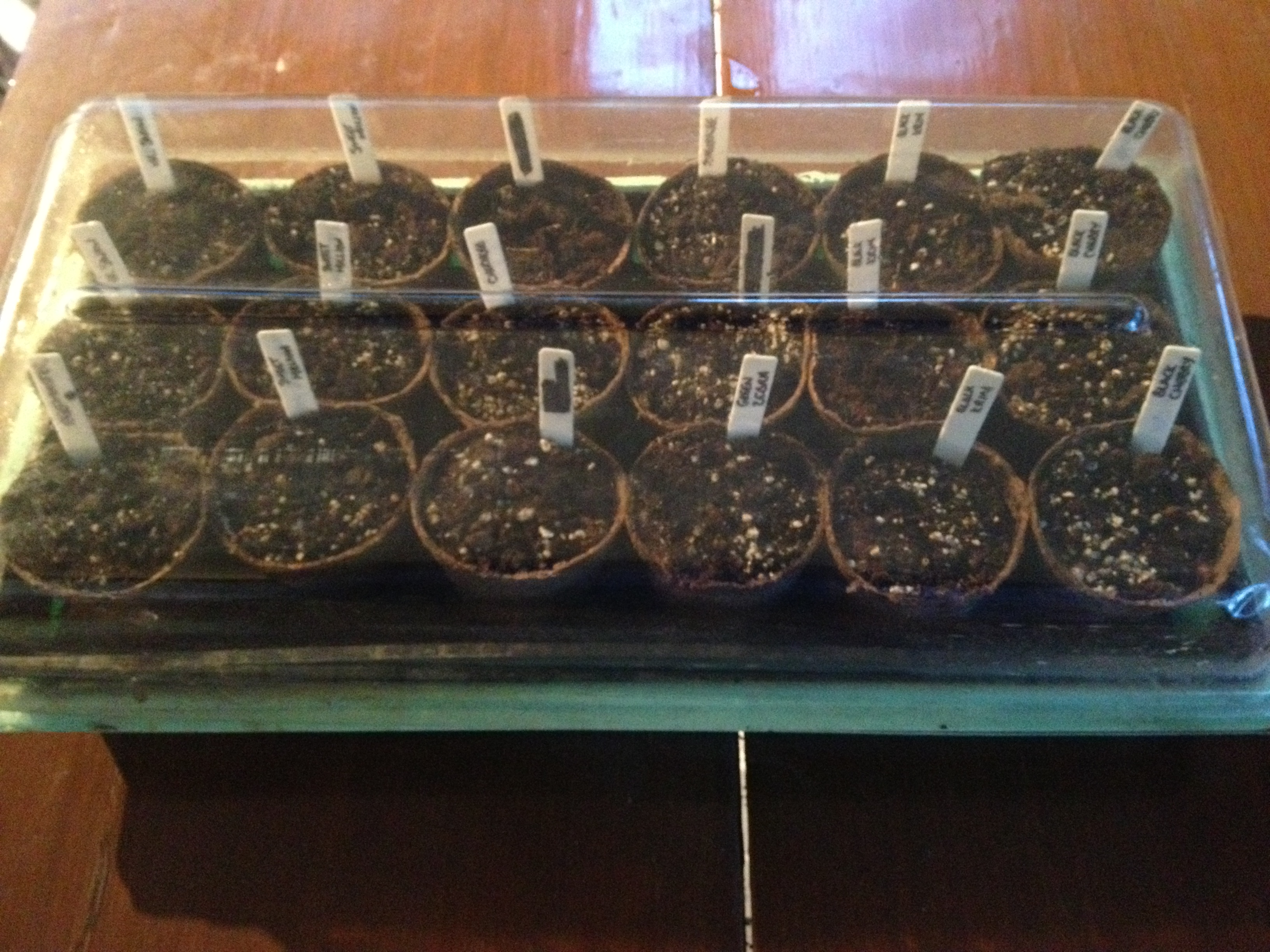
Next, I plant the seeds.  I plant between two and four seeds in each individual container and make sure they’re covered with the right amount of dirt.  Most of the seeds I plant are pretty small, and they do not need to be planted too deep—I usually double check the seed packet to make sure I’m planting at the right depth.  I learned a neat trick from a gardening magazine—use a small wooden skewer or a pencil to plant small seeds.  If you dip the dull end of the skewer into water and then touch the seed with it, the seed will adhere.  When you stick the skewer into the dirt, it will stay there.  Also, I find it useful to place the label in the pot before I plant—that way, I know what I’m supposed to plant where.

2 Planting

Next, I water in the seeds and cover them with a clear plastic lid, which will lock in moisture and heat.  Plastic wrap would work, too, but I like the dome lids because they are a little more forgiving and don’t have to be removed as soon as the seeds germinate.
3 Done

After Planting
I’ll be sure to take photos of my seedlings as they grow, but there are a couple of things that I might as well address while I’m thinking about it.

Watering.  I need to make sure that the seedlings’ soil stays moist, but not wet.  I try to remember to use room temperature water so I don’t shock the tiny roots with cold water.
Thinning.  Remember when I said that I plant between two and four seeds per container?  That’s in case one of the seeds doesn’t germinate.  If all of the seeds germinate, I need to thin the seedlings by cutting off the weaker of the seedlings (I was told to use scissors because pulling the weak seedling may disturb the roots of the one I’m keeping).
Fertilizing.  Because I’m growing my seedlings in a soilless medium, I need to feed them with a water soluble fertilizer.  I do not feed them until they’ve got their first true leaves (as opposed to the cotyledons—the embryonic leaves that are the first to emerge).
Hardening off.  I’ve spent all this time and energy growing my seedlings in the comfort of my laundry room, so it would be terrible if they died because I exposed them to the elements without giving them a chance to adjust.  One year, I put my tomatoes in the Middle Georgia sun without adequately hardening them, and they got sunburned.  I felt awful.  Plus, it took time for those babies to recover, so my fruit production was delayed.  That’s why it’s important to harden off your seedlings—they’ve got to be tough to make it outside.  A couple weeks before transplanting, I take the plants outside during the day and put them in a relatively protected place away from strong wind, strong rain, and intense sun.  I bring them inside or at least into the carport at night.  About a week before transplant, I can leave them outside at night, and I gradually increase the amount of sun they get during the day.

Good luck to you as you start your own seeds!  And let me know if you have gardening questions.

Leave a comment »

It Helps to Have a Plan

There is a narrow fenced stretch of land on the northern side of my house that gets plenty of sun in the summer.  In a previous life, that little plot was a dog run.  I decided to make it a vegetable garden.

I had my first vegetable garden in 2008, the year I bought my house.  I tried a few tomatoes but wasn’t incredibly successful, mainly because I tried to water everything by hand.  This approach does not work well if you go out of town, run out of time, or just plain forget.  The next summer, I discovered “Zone 7” on the irrigation system that came with the house; if I turned on “Zone 7,” little misters popped up in the middle of the dog run-turned-vegetable garden.  It wasn’t perfect, but it’s what I had.  I added a few more tomatoes, some cucumbers, and some bush beans.  It was an okay harvest.

My vegetable garden improved dramatically in 2010.  There are three main reasons why.  First, I took the master gardener course in the fall of 2009, and the vegetable gardening class by Bob Westerfield was highly informative.  Second, Daddy built me raised beds for Christmas in 2009.  Third, I discovered drip irrigation (which was especially helpful since the Zone 7 misters were buried under the raised beds).

Since 2010, I have taken the same basic approach to my vegetable garden.  I plot out on paper what I am going to plant in each bed and when, then I figure out when I need to plant the seeds.  For vegetables that need to be started indoors and then transplanted, I start the seeds (it’s certainly not necessary for you to start your own seeds, but if you have time, space, and adequate lighting, go for it).  Later, I run a soil test through the UGA extension service, I prepare the beds, then I plant the veggies and keep notes on my successes and failures.  But I’m getting ahead of myself.

My vegetable garden site meets the main requirements for a good site:

  • More than eight hours of full sun per day in the summer.  If you don’t get six to eight hours of full sun, you won’t have good results with vegetables like beans, tomatoes, peppers, and eggplant.  You can still grow leafy greens in less-than-ideal light situations, but they do need some full sun during the day.  If you do not have a good site for a large-scale garden because you don’t get enough sun, I highly recommend trying containers in a sunny spot—you can grow just about any vegetable in a container.  More on that in a later post.
  • Conveniently located near the house so I can keep an eye on things.
  • Near a water supply.
  • Not near trees and shrubs with extensive root systems (which can affect nutrient and water uptake of veggies).
  • Drains well, especially after a heavy rain.
  • Quality soil.  I filled the beds with quality soil, peat moss, and compost, so I am confident in the quality of the soil.  I add compost every year, and I add lime if the extension service soil test tells me to do so.  More on soil preparation in a later post.

The only downside about my vegetable garden site: I cannot use it year-round because it does not get enough sun during the winter.  So I plant my collards and broccoli in the flower bed on the south side of the house, and I plant my lettuce and parsley in containers on the front porch.

In the vegetable garden area, I have five raised 5×4 beds for vegetables and two smaller raised beds for herbs.  In the herb section, I always have basil, oregano, thyme, sage, rosemary, lavender, and mint.  With the exception of the basil, the herbs are perennials, so I don’t have to worry much about them other than summertime irrigation.  In the vegetable section, I only grow the vegetables I like most and will therefore eat.  Don’t grow vegetables you (and your neighbors/local food bank) don’t like to eat regularly.  Several years ago, Daddy grew radishes because he heard they were easy to grow.  They are.  So Daddy and Mama were overrun with more radishes than they could eat, and after a while none of their neighbors wanted them, either.  Daddy is no longer allowed to plant radishes.

My list of favorites: tomatoes, okra, peppers, cucumbers, zucchini, pole beans, lima beans, eggplant, and snow peas.  I’d like to try asparagus, but asparagus is a perennial and I’m not ready for that kind of commitment.  Anyway, with the exception of the snow peas, these are all summer crops.  After hours of leafing through catalogs and deciding on the perfect line-up based on my available space, I selected and purchased the seeds.  If you’re not sure what you should to plant, get started with the UGA cooperative extension’s list of recommended vegetable varieties for Georgia (Table 7).

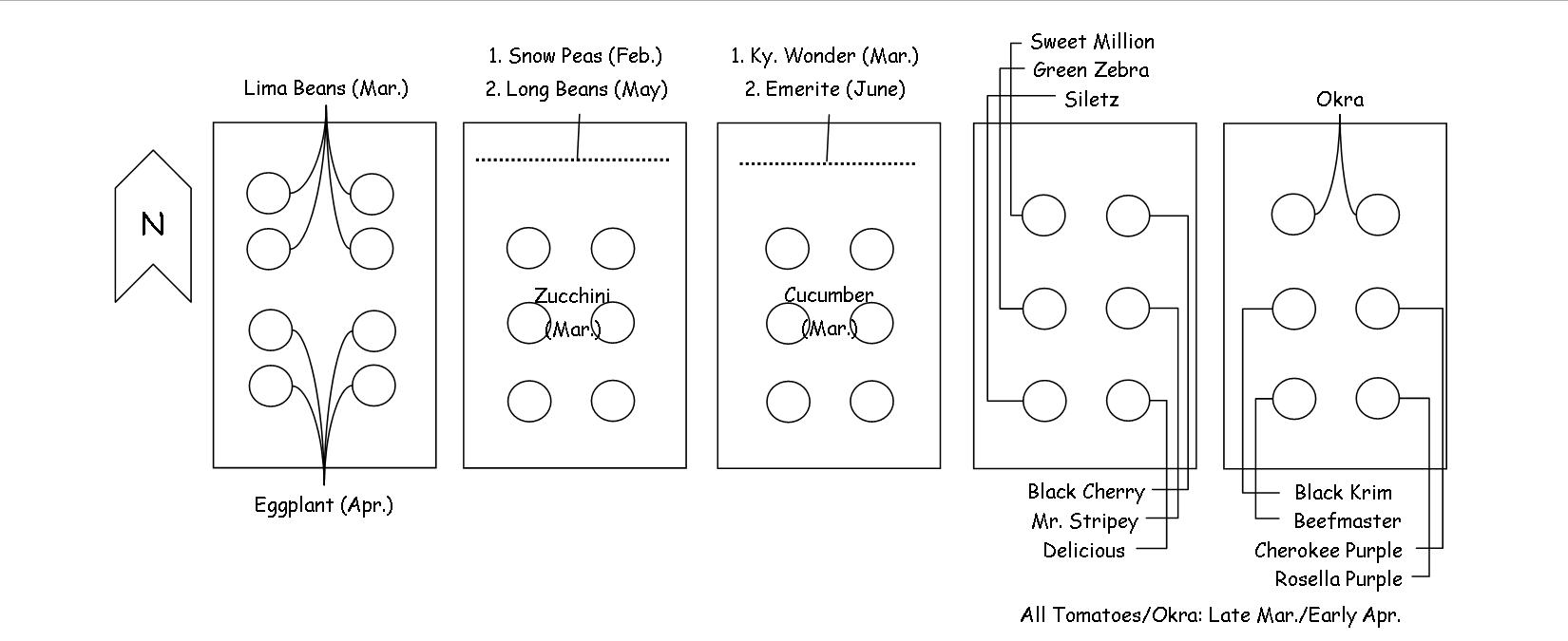
Now I just need to figure out where the plants will go and when to start the seeds.  I know that tall-growing plants like pole beans and okra should be planted on the north side of the garden so that they will not shade other plants.  I also know that the east side of the garden tends to get a little more sun than the west because of my neighbor’s tree.  I try to do “succession planting,” which means that I plant another in-season crop soon after the last harvest of another crop.  This technique works especially well with short season crops like beans and snow peas.  For example, I plant snow peas in February, and they are finished by May; when I take up the snow peas, I plant pole beans.  I must make a note on my garden plan to remind myself of these intentions.  Also, I have decided this year that I will start one row of beans much earlier than the second row of beans so that I’m not eating beans at every meal.  Based on these considerations, I’m ready to plot out the garden plan.

Plot 2013

Now that I’ve got my map, I can figure out when I need to plant what.  Pole beans are not easily transplanted, so I definitely want to sow those directly into the ground sometime near my 50% frost date, March 23 (note: the 50% frost date is the date after which there is only a 50% chance of frost—for more info on frost dates, see What is a Frost Date?).  Cucumbers, zucchini, and peas can be transplanted, but they require extra care in the process, so I usually direct sow those, as well.  I will start the snow peas by mid-February.  The rest I will start near my 50% frost date.

As for the rest of the plants, I can start them indoors or purchase plants at a nursery for transplant.  If I purchase plants at a nursery, I try to purchase them very close to the time I will transplant them—if I buy too early, I may forget to water them.  Usually, though, I start the seeds myself.  Tomatoes, peppers, and eggplants take between six and eight weeks to reach transplant size, so if I want to transplant them outside in March, I need to start the seeds in late January or early February.

Next week, it will be time to start my tomato seeds, so next week’s post will focus on seed starting.  Meanwhile, let me know if you have gardening questions!

Leave a comment »

Look Sharp!

Gardeners get more done in less time with clean, sharp gardening tools.  January is a great time to sharpen your tools.  January is also a good time to drain and replace the oil in your lawnmower and have the blade sharpened or replaced.

If you live in the Columbus area, there is a hands-on workshop this weekend that you may want to attend.  Master gardener Bill Kes will show you how to sharpen your pruning tools.  In just an hour or so, you can learn from Bill and get your hand pruners or lopping shears sharpened!

When: Saturday, January 12, 2013
Morning Session: 10:00, Afternoon Session: 2:00
Where: Columbus Botanical Garden, 3603 Weems Road
Cost: $15 for members, $20 for non-members
Space is limited, so register now.
Visit http://columbusbotanicalgarden.com/event/tool-time-sharpening-pruning-tools-morning/ to register and to get more information.

Later this month, on January 26, Bill will be back at the Columbus Botanical Garden to conduct a workshop on sharpening digging tools, such as shovels, hoes, and hand spades.  For more information, visit http://columbusbotanicalgarden.com/event/tool-time-sharpening-digging-tools-morning-session/.

Leave a comment »