Georgia Garden Girl

Garden Great in Zone 8!

Fun with Hypertufa!

Last Saturday, I attended an exciting workshop on hypertufa at the Columbus Botanical Garden.  Toni Fogle, a lawyer-turned-hypertufa enthusiast, taught a gaggle of ladies and one gentleman how to craft our own (relatively) lightweight stone-like containers.  We had a super time getting dirty and sculpting our vessels.

Ms. Fogle learned how to make hypertufa from her mother, who makes hypertufa containers for the Cox Arboretum in Dayton, Ohio.  Ms. Fogle now lives in Columbus, is a member of the Azalea Garden Club, and hosts hypertufa workshops at her home.  She repeatedly emphasized that she is not an expert, but she sure seemed like an expert to me.  She had an answer for every question, and she really knew her stuff!

So what is hypertufa?  It is a popular medium for making garden pots, troughs, and ornaments.  It has a stone-like appearance but is much lighter.  Hypertufa is made of Portland cement and peat, plus either perlite or vermiculite (and maybe sand, depending on the recipe).  And when you’re molding it, it’s like Play-Doh for grown ups, y’all.

At our workshop, we used a formulation comprised of 2 parts Portland cement, 3 parts peat, and 3 parts perlite, plus a handful of fiber mesh.  A couple notes on the ingredients.

  • First, I’ve mentioned before that some gardeners are concerned that peat is becoming an unsustainable resource, so I wondered whether a peat substitute could be used.  Short answer: yes, though the quality of the finished product may be different than a container made with peat.  If you’re concerned about peat, you can use coir or a fine grade composted bark.
  • Second, I wasn’t sure where to get fiber mesh, which is a reinforcing fiber used in concrete.  Turns out you can buy it at amazon.com.  Or if you know someone who works in construction, they can probably sell you a bit—it only takes a pinch to make a hypertufa container.
  • Third, if you want to buy perlite and vermiculite, the big box stores will charge you an arm and a leg for a tiny bag.  If you want to pay an arm and a leg, I suppose that’s your journey.  But if you want to be thrifty, go to your local feed and seed store.  Columbus folks can just go across the Chattahoochee to B.W. Capps in Phenix City—you can get a 4 cubic foot bag of perlite for $17.50 and a 4 cubic foot bag of vermiculite for $17.99.

In addition to the ingredients, you’ll need safety equipment, mixing container, a sturdy table, a plastic tablecloth, a form, some plastic bags grocery store bags with handles, and a large plastic trash bag for each form.

  • Safety equipment.  Hypertufa involves concrete, and you don’t want to breathe in concrete dust or get it in your eyes or your jewelry/watch.  So when you are mixing the hypertufa ingredients, leave your jewelry and watch inside and wear safety glasses, a dust mask, and gloves.  You can ditch the glasses and mask while you’re molding the hypertufa, but keep on your rubber gloves.
  • Mixing container.  You need a place to mix the ingredients.  A wheelbarrow or a large plastic container will work.
  • Sturdy table.  It is important to have a sturdy work surface so that your hypertufa doesn’t jiggle a lot while you’re making it.  Jiggling leads to cracks.
  • Plastic tablecloth.  Ms. Fogle recommends plastic tablecloths from the dollar store, although heavy duty plastic drop cloths will also work (but they’re more expensive).  The tablecloth has two purposes.  First, it covers your workspace so your table doesn’t get messy.  Second, when you are finished molding your hypertufa, you will use the plastic tablecloth to cover it.
  • Form (or not).  You can do free form hypertufa, but the workshop did not cover that. We learned how to make hypertufa using a form.  I used a small plastic bowl that was fairly rigid.  You could also use a plastic flower pot, a sturdy plastic bag (like a cat litter bag), or even a cardboard box.  If you are using an “outside in” approach (molding the hypertufa on the outside of your form), make sure your form doesn’t have a lip.  If you are using an “inside out” approach (molding the hypertufa on the inside of your form), make sure your form isn’t too rigid.
  • Plastic grocery store bags.  You need a plastic grocery store bag or two to cover or line your form.  The handles will make it easier to pull out your form when your hypertufa is dry.  If your bag seems flimsy, use two.
  • Large plastic trash bag.  You will use the bag to wrap your hypertufa for drying and seasoning.

Once you have your gear, you’re ready to start!  Before you mix the ingredients, have your form prepared—it should be covered in plastic grocery bags and sitting in your large plastic trash bag.

My Form: a Small, Plastic Bowl

My Form: a Small, Plastic Bowl

My Form: Wrapped and Ready to Go

My Form: Wrapped and Ready to Go

Mix your ingredients and slowly add water until your mixture is the consistency of cottage cheese.
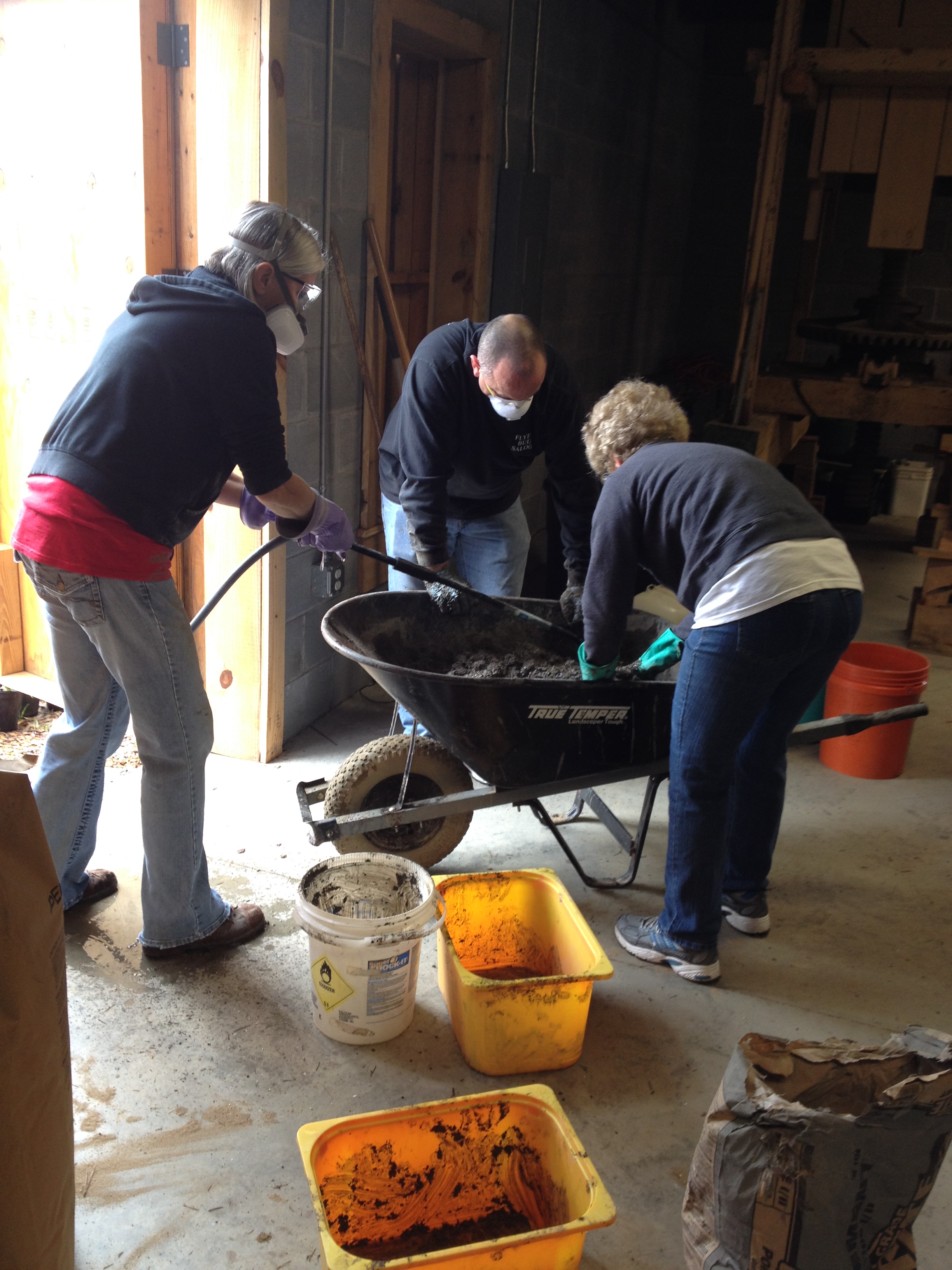
Mixing the Hypertufa

Mixing the Hypertufa

Then, when you start, you must keep going until you’re finished.  Build from the bottom of your form, keeping a depth of at least 1.5 inches, especially at the corners.  You will be tempted to press the mixture with your fingers, but Ms. Fogle recommends focusing on using your thumb to tamp down the mixture while using your fingers simply to hold it in place.  If you get puddles of water, you’re squeezing too hard!  And when you get to the bottom of your vessel, make sure it is flat.  You can use your finger (or a dowel) to check the depth and make a drainage hole.
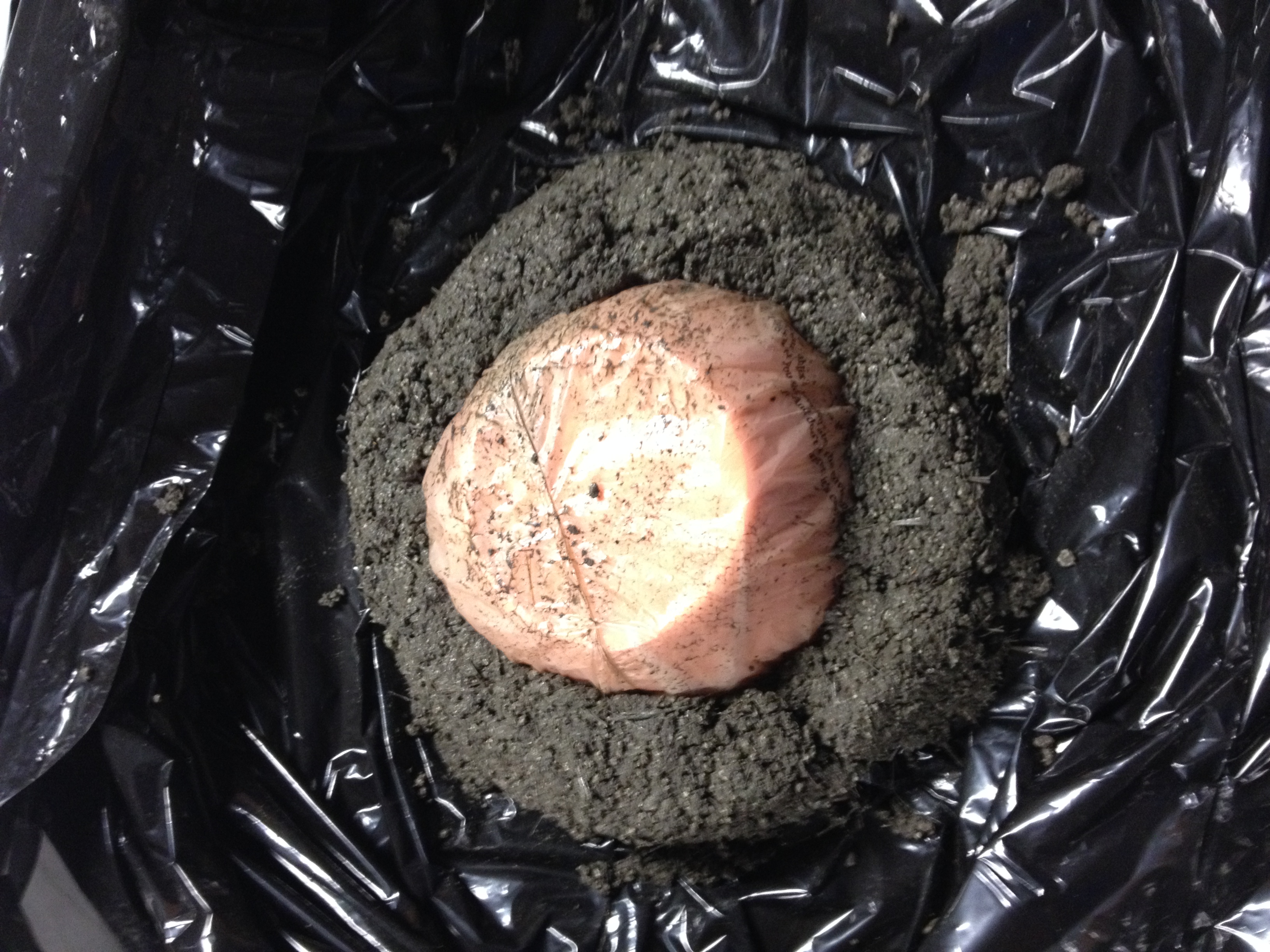
Getting Started

Getting Started

Finished!

Finished!

More Hypertufa Artisans

More Hypertufa Artisans

After you finish molding your hypertufa, the waiting begins.  Carefully fold the garbage bag over your hypertufa and then fold the plastic tablecloth on top of the garbage bag.

Wrapped and Waiting

Wrapped and Waiting

Ms. Fogle emphasized that you should not tinker with your hypertufa for at least three days.  After three days, you may remove the form (go slowly; note: after a tugging gently, mine popped right out).

Ready to Remove the Form

Ready to Remove the Form


My Hypertufa!

My Hypertufa!

You can use a steel brush to smooth the surface (Ms. Fogle says that she usually doesn’t bother with this step: “I’m not fancy, I’m lazy”).  And then, after that, you need to let the hypertufa season.  In other words, let it sit for a month or 45 days covered in plastic (you may want to spritz it with water occasionally during the curing process).  Then you can burn off any fiber mesh “whiskers” (Ms. Fogle uses a grill lighter; if you have a blowtorch, go for it).  Finally, allow the container to weather outdoors for several weeks.  This is not a quick process, but I’m sure it will be worth the wait!

Leave a comment »

Weekend Update

It was an exciting weekend at my house.  The weather was gorgeous, and I was able to get a lot of work done in the yard.  I also attended the hypertufa workshop at Columbus Botanical Garden—I’ll give you an update on that as soon as I pick up my beautiful creation later this week.  But I know you’re on pins and needles wanting to know what garden tasks I accomplished this weekend, so here is my report.

It is the busiest time of year for me.  I am a procrastinator by nature, so I usually put off important garden prep work until the last possible minute.  Last year, I didn’t even start building my tomato ladders until after my tomatoes were in the ground.  Big mistake.  I decapitated a poor little Cherokee Purple when I dropped one of the “rungs” on it.  And I ran out of steam when it came to weeding an area where I was going to plant tomatoes, so I decided that I would just till it, put down newspaper, and hope for the best.  Well, the newspaper did work for a while, but it was no match for the aggressive encroachment of the dollarweed a/k/a pennywort a/k/a the weedy bane of my existence (for me, the only weed worse than dollarweed is chamberbitter a/k/a little mimosa a/k/a gripeweed a/k/a just plain horrible awfulness).

This year, I am determined to do better.  And I am happy to announce that I appear to be on the right track.  Mainly because the soil temperature hasn’t reached a consistent 65°F, so I haven’t wanted to plant my veggies yet and I’ve had more time for prep work (thank you, cold snap).  If you’re not sure whether your soil is warm enough for you to plant, you can just use your meat thermometer.  Or you can check http://www.georgiaweather.net/.

Anyway, my two main tasks at this point are (1) weeding and (2) building supports for my vegetables.  This weekend was a perfect time for both tasks.  The ground was still soft from last week’s rain, so weeds came out of the ground fairly easily and the supports went into the ground without a herculean effort.  So I weeded and weeded and weeded.  Then I tied together a lot of bamboo.  And then I weeded.  Then I selected the twenty-one tomato plants (out of the fifty or so I started from seed) that will live in my yard this summer.  And then I weeded and weeded and weeded.

You may wonder why I spent so much time weeding.  First, I have a lot of weeds.  I’ve been lazy about eradicating weeds in the past, plus the two yards behind mine are basically jungles whose weeds send their seeds into my yard.  Darn them.  Second, if I’ve only learned one thing in my six years as a homeowner/aspiring gardener, it’s that there is no substitute for good old elbow grease when it comes to weeding.  I’ve tried weeding-by-tiller.  But I still have to pull up the weeds to prevent re-infestation.  I’ve tried a weed-whacker.  But I wasn’t getting the roots, so the weeds grew back, plus it was easy to maim the plants I wanted to keep.  I’ve tried an herbicide.  But I accidentally injured or killed some of my good plants when I did.  So for me, old fashioned pulling is the way to go.  Which means I actually have to do it or I’ll be overrun with weeds before the first tomato plant sets fruit.  At times, I feel like Sisyphus—but instead of a boulder and a hill, I have weeds.  But if I keep up with it little by little, surely I will prevail.  And there is good news on the horizon: some researchers in Nebraska are creating a robot to pull weeds.  I am not making this up: http://www.npr.org/blogs/thesalt/2013/02/14/171817006/when-resistance-is-futile-bring-in-the-robots-to-pull-superweeds.  Y’all need to know how much I love my three Roombas.  So when iRobot comes out with a weed pulling robot, I am going to buy it.

In the next week or so, I will continue weeding, and I will put down some mulch.  I will also finish my vegetable supports and then plant my baby vegetables.  When things are presentable, I’ll post some photos!

Happy gardening!

Leave a comment »

Hypertufa Workshop This Weekend!

This Saturday, March 29, 2014, the good folks at Columbus Botanical Garden will show us how to make custom hypertufa containers.  For only $35 ($40 for non-members), you will learn how to make your very own piece of outdoor art!  The workshop is 10:00 am to 1:00 pm.  Bring rubber gloves, a large garbage bag, and a form (e.g., a plastic Rubbermaid container—make sure it’s smaller than one cubic foot).  Sign up online: http://columbusbotanicalgarden.com/event/hypertufa-workshop-2/ or call the Columbus Botanical Garden for more information – 706-327-8400.  Hope to see you there!

Image

Photo courtesy of Columbus Botanical Garden.

If you can’t make it to the workshop but are interested in learning more about hypertufa, check out:
http://www.marthastewart.com/268091/pots-with-a-personal-touch-hypertufa:
http://www.lowes.com/creative-ideas/woodworking-and-crafts/make-hypertufa-pots/project

Leave a comment »

Shelter Them

In case you haven’t heard, we are expecting a freeze TONIGHT, March 25, in middle Georgia. So, if you have started hardening off your summer annuals outside, double check your local forecast. If you’re expecting below the low 30s, bring those babies inside! And if you got a little ahead of the weatherman and already planted your tomatoes, be sure that you cover them tomorrow evening.

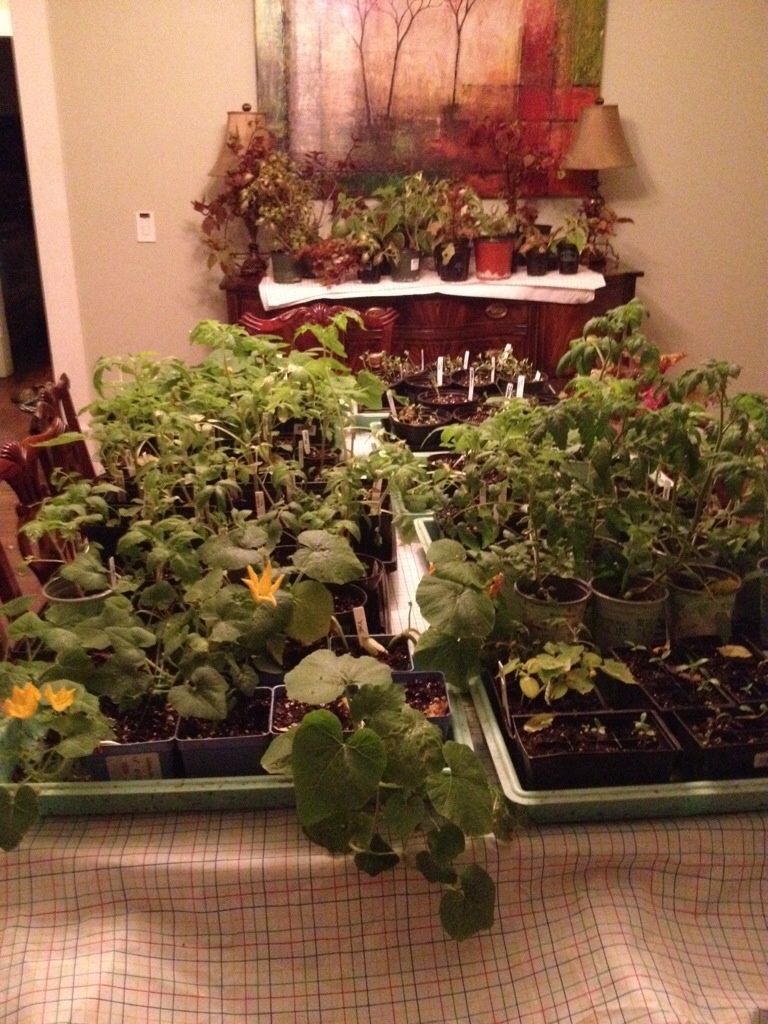
I went ahead and brought in my plants yesterday evening. They will go back outside later in the week. But for now, they have taken over the dining room.

I hope you and your plants weather the freeze!

20140324-210041.jpg

Leave a comment »

Tough Love

Happy Spring, y’all!

I started my tomato and pepper seeds indoors back in January, and I started some other vegetables in February.  These veggies have been living in the lap of luxury in my laundry room—a constant, warm temperature, regular watering with a light stream of tepid water, and gentle yet effective lights.

Now, it is time to prepare my plants for the harsh realities of the world.  They will have to be tough to make it out there, where the temperature fluctuates, cold rain pours, wind blows, and the sunlight is a lot more intense than a little fluorescent shop light.

Obviously, I should not just go ahead and move the plants into the direct sunlight of the vegetable garden.  They need to be moved gradually so they have a chance to adjust.  This process is called “hardening off.”  And it is very, very important.  I learned this lesson the hard way.  During the first year of my vegetable garden, I grew some beautiful tomato plants from seed, and I was itching to get them into the ground.  So I took them from the laundry room where they had been coddled for two months and planted them directly in my raised beds.  Big mistake.  On their first day outside, the sun badly burned the leaves.  Though the plants eventually recovered, my mistake cost me about a month of tomato production time.  I will never make that mistake again.

Now, I have a five-step process for hardening off my plants.  First, I have to figure out when to start hardening off.  A lot of considerations are factored into the calculus of exactly when to start hardening off.  There’s the date (are we within a week or two of our 50% frost date?).  There’s the weather (is there a threat of a frost? will the temperatures generally be in the mid-40s or above at night? are we expecting a monsoon?).  There’s the soil temperature (is it getting close to 60°F?).  In general, I try to start hardening off the plants a week or two before our 50% frost date, which is March 23 in my part of Middle Georgia.  But if it looks like there will be a frost or a bad storm, I will wait.

After I calculate my hardening off start date, I’m ready to move to steps two through five.  Step Two: I start the hardening off process in the carport.

Carport

Step Three: after a couple days in the carport, I move the plants to a shady part of my deck.  Step Four: after a couple days there, I move the plants to a partly sunny part of the deck.  Step Five: after a few more days, I move the plants to a slightly sunnier part of the vegetable garden.  And then, after a few more days, the plants are sufficiently hardened off and ready to be moved to their beds.  Right now, my plants are somewhere between Step Two and Step Three (sorry – I forgot to take a picture).

While you’re hardening off your plants, be careful to watch the weather reports.  If you know there will be a bad storm, you probably want to bring the plants under cover—or at least out of the path of potential falling branches.  And watch the nighttime temperature.  In the 40s, tomatoes and peppers will probably be okay. But not okra.  Last weekend, the nighttime temperatures dipped into the low 40s, and my smallest okra showed serious signs of distress, so it and its brethren are now back inside for a few more days.

The fine folks at the Weather Channel are predicting overnight lows in the low 30s in Middle Georgia on Tuesday and Wednesday of next week; I will keep an eye on the predictions.  If the temperatures do get that close to freezing, I will need to schlep everything back inside at night.

Good luck with your own tough love!

1 Comment »

Lazy Girl’s Guide to Orchid Maintenance

I get a lot of questions from friends about how to care for plants.  The questions about outdoor plants are all over the map (Q: how long will it take my new blueberry bush to produce? A: about 3 years; Q: why did my basil plant turn black? A: it froze; Q: the best thing for my lawn would be to set it on fire and reseed, right? A: Um, wrong.).  But the vast majority of questions about indoor plants are about one type: the phalaenopsis orchid.  Folks are so worried about what to do with these plants!  So today, I would like to dispel some rumors about orchids.

Phalaenopsis orchids (a/k/a moth orchids) are lovely.  Their blooms last at least a month.  They are widely available at florist shops, grocery stores, and big box stores—especially around Valentine’s Day and Mother’s Day.  Phalaenopsis orchids make a wonderful gift, and that gift could last for years (my oldest phalaenopsis is at least ten years old).

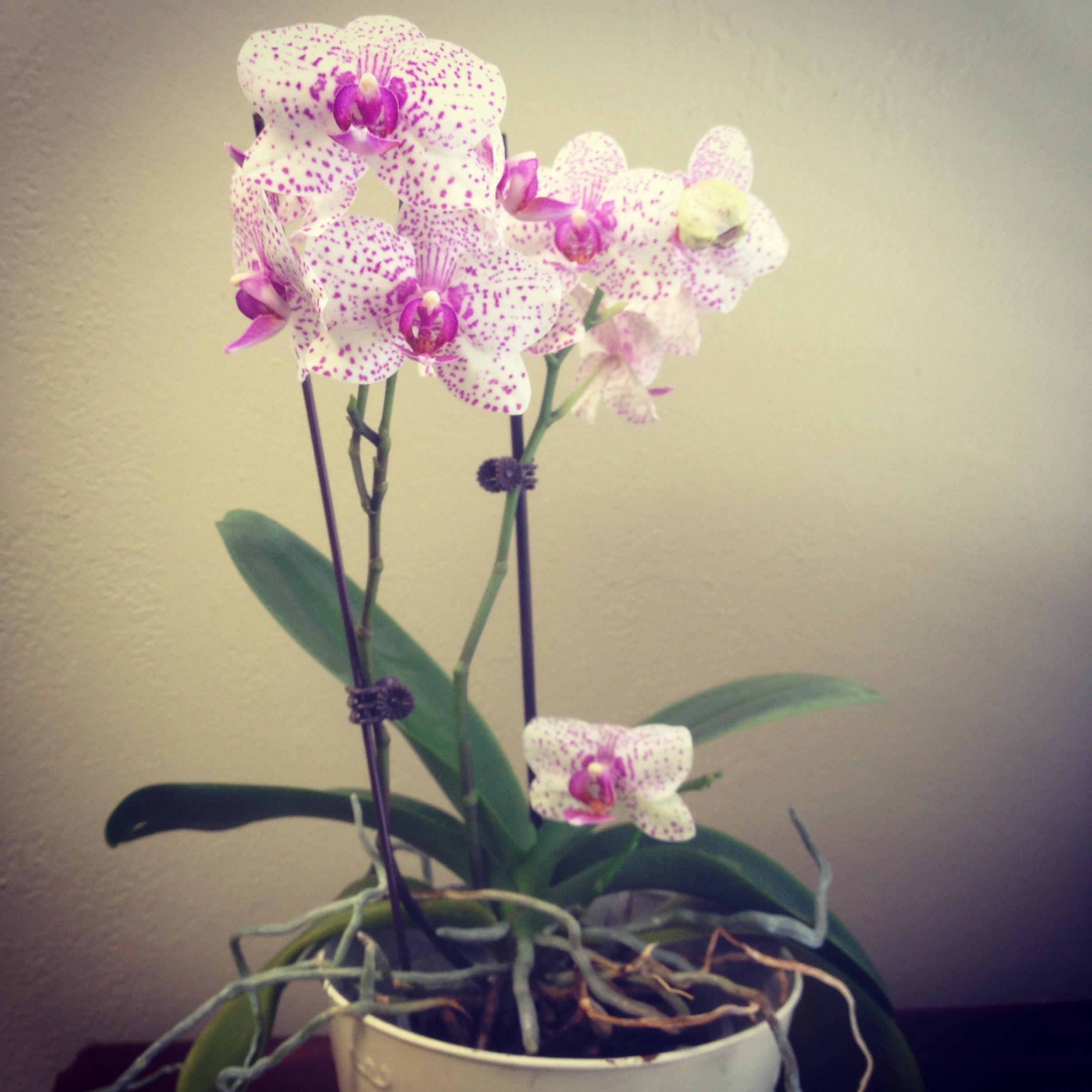
Most folks think that orchids are fussy and hard to grow.  I too had been led to believe that orchids must be coddled with special light, special fertilizer, and constant care.  Hogwash!  I have had excellent results without spritzing “just so” or even remembering to fertilize on a regular basis.  In fact, all of my phalaenopsis orchids are currently blooming.  Do they look exactly like the ones that were carefully raised in a fancy commercial greenhouse?  Mercy, no.  But they do have flowers, and I think they’re glorious.  See?

IMG_2080   Office Orchid

Here are the major steps I followed.  Disclaimer: my “techniques” have not been approved by any extension services or orchid societies.  Obviously.

  1. I put them near a window.  Phalaenopsis orchids are great because they don’t require a whole lot of light, and they are happy with the temperature in my house (between 65º F and 80º F, depending on the season).  Before I had my shop light set-up in the laundry room, I kept my orchids in a bright window, and that worked just fine.  Now, they are under the shop lights until they bloom.  When an orchid is blooming, I usually put it on display somewhere out of direct light so that the blooms will last longer.  If it’s been a while since your orchid bloomed, it might need more light.
  2. I did not repot them in soil.  Your orchid will likely come potted in bark or moss.  That is because orchids grow best in soilless mixtures.  The experts say to repot orchids every one to three years.  Um, okay.  My orchids are not on an official schedule.  When the roots are spilling out of the containers, I think, “Hey, maybe I should repot that.”  If I have the same thought several times and I happen to have some orchid potting mixture handy, then I might repot the orchid.  But I do always use an orchid potting mixture and not regular potting soil.
  3. I did not let them sit in water (most of the time), and I did not forget to water them (most of the time).  The experts will tell you to water in the morning, placing the plant in the sink and using tepid water and an elaborate ritual that involves letting the water run through the plants for a minute/letting the plant drain completely/gently wiping excess water off the leaves.  If you have time to do that, great.  If not, just make sure they do get watered.  Let them dry out a little before you water them again—if the pot feels heavy, skip watering.  My orchids are all potted in a bark medium in plastic pots.  The pots sit in seedling trays.  I spray water into their pots using an indoor hose that is connected to the laundry room sink.  Occasionally, I accidentally overwater, and water remains in the tray/on the leaves.  They lived.  And although I know I’m not supposed to let the orchids dry out completely, it has happened.  They lived.  My orchids are not on a strict watering schedule, but I’d say I typically remember to water them about once a week.
  4. I occasionally remembered to fertilize them.  But really not that often.  The experts advise using an orchid fertilizer.  Some even recommend special fertilizers based on the season—a high nitrogen fertilizer in the spring, and a high phosphorous fertilizer in the fall.  They recommend feeding weakly (about half strength) weekly or feeding monthly.  Yep.  I haven’t quite gotten there yet.  I do know that too much fertilizer is bad, so I don’t feel terrible about forgetting to fertilize the orchids.  I bought some orchid “bloom booster” fertilizer several years ago, and when I happen to see it sitting on the shelf and happen to have a gallon jug free, I might mix up a batch and feed the orchids.  It might happen once a quarter.
  5. I did not expect miracles.  Phalaenopsis orchids bloom once a year.  That’s it.  So I knew that I wasn’t going to get more flowers shortly after the old ones faded.  Okay, if you know how to prune the stem, you might get a second bloom.  I have never had much success with stem pruning, so I just cut the stem off when the flowers have faded and wait until next year’s blooms.  When the orchid does bloom, the flowers last for weeks.

Now, as you can see, orchids need not be daunting.  They can be beautiful even with imperfect care.  But if you are interested in knowing how to grow orchids the “right way,” check out the tips from the American Orchid Society.

3 Comments »

Time to Get Ready

Y’all may as well know.  I love to-do lists.  I love making to-do lists, and I especially love crossing things off my to-do lists.  It’s just about time for the weekend, and that means that my garden to-do list is getting long!

We’ve had some glorious weather in middle Georgia over the past couple of days (though it did get downright cold last night).  I’m sorry to say that our friends at the Weather Channel are not predicting similar gloriousness this weekend.  It is supposed to be cloudy on Saturday and rainy on Sunday.  But that will not stop me from trying to cross a few things off my list:

  • Divide perennials and give leftovers to friends.  I didn’t get around to dividing my spring and summer perennials at the ideal time (October).  It was football season—give me a break.  But now is also a good time to divide.  Mama says, “If you have to buy hostas, you don’t have any friends.”  So get digging and share your wealth of daisies, hostas, black eyed susans, sedums, etc.
  • Weed and mulch perennial beds.  While I’m dividing the perennials, I may as well pull some weeds and then put down some mulch.  If I’m feeling extra industrious, I’ll mulch with old newspapers and then pinestraw—that will save me some weeding time in the summer.
  • Start hardening off vegetable seedlings and coleus plants.  I overwintered my coleus plants inside and rooted some new ones.  Now, I have six flats of coleus plants, and I’m ready to get them out of the kitchen/dining room/living room.  And I started my tomato and pepper seeds back in January, plus some other veggie seeds in February.  They are getting too big to stay under the lights.  Here’s what they looked like last weekend:
    20140309
    (Yes, those are pumpkins in the middle on the bottom—I was doing some germination tests, and I’ve decided to keep on testing.  Don’t judge).
    Anyway, before I plant any of these babies outside (which I will NOT be doing this weekend), I need to get them used to the sun and the temperature.  So, I will put them outside in a shaded, sheltered location for a few days, and I will gradually transition them into the sunny spot where they will spend the summer.  And if I receive a frost warning, I will bring them right back inside!
  • Check outdoor faucets and hoses for leaks.  My plumber friend is coming by next week to give me an estimate on a bathroom remodel.  While he is at my house, I may as well see if he can fix any outdoor faucet leaks, which means that I need to figure out where the leaks are this weekend.
  • Prune the dwarf yaupons.  It’s a good time to prune ornamentals like hollies and boxwoods.  And if your oleander froze, you probably want to cut that back too.  For pruning tips, click here.
  • Trim the liriope.  Okay, I’ve already done this one.  Isn’t it nice to have something already off the list?  But if you haven’t trimmed your liriope, you probably want to go ahead and get that done before the new growth starts.  Just take a string trimmer to it.  Or, if it’s a large area of liriope and there are no nearby barriers (say, metal or concrete edging), just take your mower, set it to its highest setting, and mow the liriope.

One thing I will NOT be doing this weekend is planting my summer vegetables outside.  I know they’ve got them in the stores, but that doesn’t mean you need to plant them.  Our 50% frost date isn’t even until next Sunday, March 23.  Plus, the soil temperature isn’t warm enough yet.  It is getting mighty close, though.  Remember, we need the soil temperature to be at least 60°F for tomatoes, 65°F for okra, and 70°F for peppers.  Down in Quitman County, the 2 inch soil temperature was about 60°F earlier today, and the 4 inch soil temperature was 56.8°F.  Up in Harris County, the 2 inch soil temperature was 58.7°F, and the 4 inch soil temperature was 53.7°F.  You can check your soil temperature using a meat thermometer.  Or you can go to http://georgiaweather.net/.  The upshot: don’t plant your summer vegetables outside now unless you want to (a) stunt their growth and (b) cover them or dig them up in the event of a frost.  All right.  I’ll get off the soapbox now.  If you really want to plant your tomatoes now, that’s your journey.

I hope you have a marvelous weekend.  And I hope you cross many tasks off your to-do list!

Leave a comment »

My Action-Packed Weekend

What a lovely weekend in Zone 8! Sunshine and 70s. Daffodils and hellebores blooming. Bees buzzing around blueberry flowers. New perennial leaves peeking out of the ground. Green grass blades appearing here and there. Viburnums preparing to put on a beautiful display.

It was a great weekend to get some of those late winter/early spring tasks done, so my weekend was action-packed (granted, my definition of “action-packed” may not be the same as yours):

  • Pruned the oleander, which had been hit hard by the recent freezes.
  • Pruned the roses.
  • Cut the suckers off the cherry tree.
  • Checked the hoses and sprayer nozzles for leaks.
  • Dug up some azaleas that I never liked (my predecessor apparently loved red and Pepto-Bismol pink together) and replaced them with baby hellebores from Sunshine Farm & Gardens.
  • Planted the strawberries I had divided several weeks ago.
  • Interplanted roses and strawberries with onions (per the recommendation of the book Carrots Love Tomatoes).
  • Moved some perennials and started making a map of where to plant new ones.
  • Finished building raised beds around my new asparagus crowns, which went in the ground back in February.
  • Planted the fatsia I’ve been meaning to plant for ages.
  • Replaced my sweet, precious winter Daphne (may she rest in peace) with a new one.
  • Repotted some of the coleus I’ve been overwintering inside and started setting it out to harden off.

There were, of course, unpleasant surprises.  I learned the hard way that a colony of fire ants happily spent the winter in my large blue strawberry pot (thank you, Benadryl cream, for fixing my hand).  I noticed that many of my more tender perennials are gone—likely due to a combination of the recent freezes and my former yard man’s eager weed whacker.   And I did make a mistake or two. The most significant one: I followed the package directions on the caladium bulbs and went ahead and planted them BEFORE consulting an expert. Oops. Walter Reeves says that caladiums are tropical and should not go into the ground until the soil temperature is 65°. That’s okra planting weather, y’all. Oh, well. If I had followed my initial inclination to start them in pots, there would be no problem. Or if I had at least marked them, I could dig them up. But I didn’t, so I will just hope they come up anyway.

It is Monday, and I’m a little achy after all that work. But the pile of branches at the street is impressive, and I am glad to see everything start to shape up for spring.

Leave a comment »

Breaking Up Is Hard To Do

My Great Aunt Ada had a marvelous yard man for years and years.  He did a wonderful job in her yard and kept everything looking beautiful.  One day, Aunt Ada asked the yard man to fertilize some roses.  The yard man got mixed up about which bag contained the fertilizer, and he accidentally selected a bag of Quickcrete.  Aunt Ada felt that the mix-up was her fault, and she didn’t want the poor yard man to feel bad about killing the roses.  So, legend has it that she did what any polite Southern lady would do: she hired another yard man to dig up the old roses and put in new ones.

I have tried to have the patience and grace of Aunt Ada with my most recent yard man and his crew.  I know that they need a job, and I am terrible with confrontation.  That is how I ended up with a yard man in the first place.  I did not want a yard man.  I actually like cutting the grass, and I find it satisfying to pull weeds.  But a while back, I broke my lawnmower and could not get it fixed before it was my turn to host Junior League Book Club.  It is obviously unacceptable to host any Junior League function with a jungle-like yard, and I needed a one-time mow and blow to get me out of this jam.  A sweet friend recommended her yard man, so I asked for his help.  One time.  But somehow, it turned into a relationship.  And I wasn’t sure how to end it.

The relationship got off to a rocky start when the crew weed-whacked all my groundcover sedums and a prostrate yew, destroying a perfectly good soaker hose in the process.  But I hate confrontation, and they needed a job, so I overlooked these issues.  I tried to counsel the yard man every time his crew cut the grass—they always cut it too short and usually scalped it in several places.  I tried to be patient when the crew blew leaves (and sometimes trash) into my vegetable garden, completely burying a bed of herbs nearly every time.  And I reasoned that they were just trying to help in my flower beds, so I shouldn’t be too upset that several of my perennials looked like weeds to the crew and were therefore eradicated.

But then they murdered Daphne.  My sweet, precious winter Daphne.  She was one of the first harbingers of spring—the one who always told me, “don’t worry, winter is almost over.”  She bloomed her little heart out and perfumed the air with the sweetest scent.  She was beautiful, and I loved her.  But now, Daphne is dead—the tragic victim of an overzealous weed-whacker, inexplicably cut down while she was in full bloom.  My heart is bruised, and my trust is breached.

I know I’m being a bit dramatic here, but Daphne was one of my favorite plants.  And I realize that the winter Daphne plant is replaceable.  But the trust is not so easily fixed.  I suppose that if I had years and years of good rapport with my yard man, then I could overlook this breach like Aunt Ada overlooked the Quickcrete incident.  But if I’m going to be honest, I was disappointed with the yard man from the beginning, and things only got worse every time he ignored my instructions.  I needed to fire him, and the Daphne murder gave me the perfect out.

It was harder than I thought it would be, but I finally did break up with my yard man.  It took six text messages, two phone calls, and one letter.  He groveled.  I listed his past mistakes.  He apologized.  I explained that we are just not a good fit.  He made impassioned pleas.  I almost caved.  But I stood my ground, and I know it will be better for both of us in the long run.

My lesson is learned.  Know thy yard man.  Do not trust him to work in your yard unsupervised until he proves that he can tell a perennial from a weed and knows the proper height to cut your grass.  And do not promise him a steady gig until he can prove that he is reliable, knowledgeable, and able to follow instructions.  And when the relationship goes south, do not be afraid to break up with him.  Bless his heart.

Leave a comment »

Become a Master Gardener!

Hello!

I’m sorry I’ve been out of touch this summer.  One word: weeds.  It’s Sisyphean out there, y’all.  I promise to update you soon.

In the meantime, if you’re in the Chattahoochee Valley, there is a new Master Gardener class coming up this fall.  Download the application here http://www.columbusga.org/Cooperative_Extension/.

From our Extension Agent, Jennifer Davidson:

The Master Gardener program is an education volunteer training program to extend the knowledge of the land-grant university to the local area residents through volunteerism for Cooperative Extension.  Join us for the first multi-state combined program through The University of Georgia Cooperative Extension and the Alabama Cooperative Extension System.  Classes are hosted in Columbus, Georgia.

Return applications to UGA Cooperative Extension, Columbus Office, 420 10th Street CCG Annex, Columbus GA 31901 by August 12, 2013, 5pm.

Notification of acceptance/non-acceptance will be mailed on August 13, 2013.

There will be a mandatory orientation meeting on August 20, 2013 at the UGA Cooperative Extension Columbus Office.

The class fee of $175.00 and a mandatory background screen will be due at orientation on August 20, 2013.(Class fee includes: Textbook, name badge, certificate, Master Gardener Shirt, and  field trips to Auburn, AL)

Classes will be held Tuesday and Thursday 9am to 12:00 at the CCG Annex, 420 10th Street, Columbus, 31901 (unless otherwise specified)

FOR APPLICATION:

CLASS SIZE IS LIMITED

Upon acceptance into the program you will be required to complete a 20 session (twice a week for 10 weeks) training program that will cover topics ranging from landscape design, propagation and turf, to different programs such as nuisance wildlife control.  You must volunteer at least 50 hours of service to the program after completing the course.  Volunteering can be in either state, Georgia or Alabama.

Leave a comment »